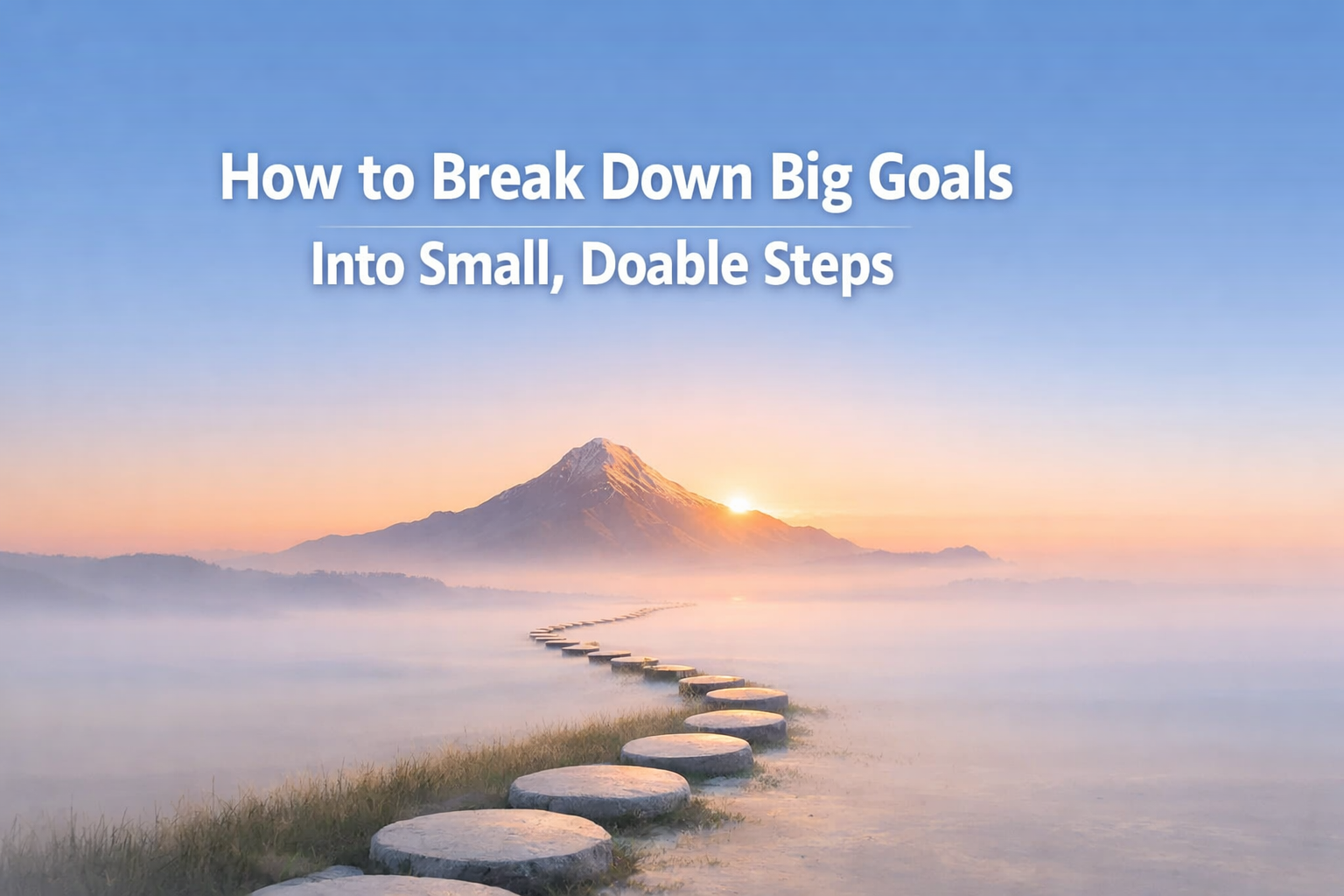
Are you also facing a problem in breaking down Big Goals into Small.
You have a big dream.
Maybe it’s starting a business. Writing a book. Getting fit. Learning a new skill. Saving a certain amount of money.
It feels exciting. It feels important.
Then you look at the gap between where you are and where you want to be.
And suddenly, it feels impossible.
Your brain freezes. You don’t know where to start. So you wait. You procrastinate. You tell yourself you’ll begin “when you’re ready.”
Here’s the truth: You don’t need to be ready. You just need to start small.
Big goals aren’t achieved in giant leaps. They’re built through tiny, consistent steps. The secret isn’t motivation. It’s method.
This guide shows you exactly how to break down any big goal into small, doable actions—so you can start today, stay consistent, and actually see progress.

No fluff. No hype. Just a simple framework that works.
Why big goals feel overwhelming and how to fix it (Big Goals Into Small)
Let’s be honest. Big goals are scary.
When you say “I want to lose 20 kg” or “I want to launch a startup,” your brain hears: This is huge. This is hard. This might fail.
That triggers stress. And stress leads to avoidance.
The Science of Overwhelm
Research from the American Psychological Association shows that when people perceive a task as too large or complex, they’re more likely to:
- Procrastinate
- Feel anxious
- Give up early
But here’s the good news: Your brain loves small wins.
When you complete a tiny task, your brain releases dopamine—the “feel-good” chemical. That motivates you to take the next step.
So the fix isn’t to try harder. It’s to start smaller.
“You don’t have to see the whole staircase. Just take the first step.” — Martin Luther King Jr.
The step-by-step framework to break down any goal
Ready to turn your big dream into action? Use this 5-step framework.
Step 1: Define Your Goal Clearly
Vague goals create vague results.
❌ “I want to get fit.” ✅ “I want to run a 5K in 3 months.”
❌ “I want to save money.” ✅ “I want to save ₹50,000 in 12 months.”
Ask yourself:
- What exactly do I want to achieve?
- How will I know when I’ve succeeded?
- What’s my deadline?
Write it down. Specificity creates clarity.
Step 2: Work Backward From the End
Start with your finish line. Then ask: What needs to happen right before that?
Example: Goal = Run a 5K in 3 months
| Timeline | Milestone |
|---|---|
| Month 3 | Run 5K without stopping |
| Month 2 | Run 3K comfortably |
| Month 1 | Run 1K without walking |
| Week 2 | Walk/run intervals for 20 mins |
| Week 1 | Walk 20 minutes, 3x this week |
See how that works? You’re not thinking about 5K today. You’re thinking about a 20-minute walk.
Step 3: Break Milestones Into Weekly Actions
Now, take each milestone and ask: What can I do this week to move toward it?
For “Walk 20 minutes, 3x this week”:
- Monday: Walk after dinner
- Wednesday: Walk during lunch break
- Saturday: Morning walk with a friend
Keep it simple. Keep it realistic.
Step 4: Shrink Actions to 2 Minutes or Less
This is the game-changer.
Take your weekly action and ask: What’s the smallest version of this?
- “Walk 20 minutes” → “Put on walking shoes”
- “Write 500 words” → “Open document and write one sentence”
- “Study for exam” → “Read one page of notes”
Why? Because starting is the hardest part. Once you begin, momentum often carries you forward.
This is the 2-Minute Rule: If a habit takes less than 2 minutes, you’re more likely to do it.
Step 5: Schedule and Stack Your Habits
Don’t leave your actions to chance. Attach them to your existing routine.
Habit stacking formula:
After [CURRENT HABIT], I will [NEW TINY ACTION].
Examples:
- “After I brush my teeth, I will put on my walking shoes.”
- “After I pour my morning coffee, I will open my study notes.”
- “After I sit at my desk, I will write one sentence.”
This makes your new habit automatic.
Real-life examples: Breaking down common big goals
Let’s see this framework in action.
🎓 Goal: Pass a Competitive Exam
Big Goal: Clear UPSC/CAT/JEE in 12 months
| Level | Action |
|---|---|
| Yearly | Complete full syllabus + 10 mock tests |
| Monthly | Finish 2 subjects + 1 full-length test |
| Weekly | Study 3 topics + 50 practice questions |
| Daily | Study 45 minutes (3 x 15-min sessions) |
| 2-Minute Start | Open textbook to today’s topic |
💼 Goal: Start a Side Business
Big Goal: Launch a freelance design service in 6 months
| Level | Action |
|---|---|
| 6 Months | Have 3 paying clients |
| 3 Months | Build portfolio + set up website |
| 1 Month | Research niche + create 3 sample projects |
| 1 Week | Sketch 1 sample project idea |
| 2-Minute Start | Open notebook and write “Who is my ideal client?” |
🏃 Goal: Get Fit and Healthy
Big Goal: Lose 15 kg and build strength in 9 months
| Level | Action |
|---|---|
| 9 Months | Reach target weight + lift weights 3x/week |
| 3 Months | Lose 5 kg + establish workout routine |
| 1 Month | Walk 30 mins daily + cook 4 healthy meals/week |
| 1 Week | Walk 3x this week + prep 2 healthy lunches |
| 2-Minute Start | Fill water bottle and place by front door |
Notice the pattern? The big goal stays the same. But the daily action is tiny, doable, and stress-free.
How to stay consistent when motivation fades
Motivation is fleeting. Systems are reliable.
Here’s how to keep going even when you don’t feel like it:
✅ Track Your Progress Visually
- Use a calendar and mark an X for each day you complete your tiny action
- Try a habit-tracking app (like Loop or Habitica)
- Keep a simple journal: “Did my step today: Yes/No”
Visual progress builds momentum.
✅ Celebrate Small Wins
Did you put on your walking shoes? That’s a win. Did you open your document? That’s a win.
Say it out loud: “I showed up.” Your brain remembers rewards.
✅ Build in Flexibility
Life happens. Some days, you’ll miss your step.
That’s okay. Use the 2-Day Rule: Never skip your habit two days in a row. Miss Monday? Just restart Tuesday.
✅ Review and Adjust Weekly
Every Sunday, spend 5 minutes asking:
- What worked this week?
- What felt hard?
- What tiny adjustment can I make next week?
Small tweaks keep your plan realistic and sustainable.
Common mistakes to avoid when setting goals
Even with a good framework, pitfalls can trip you up.
❌ Setting too many goals at once
Focus on ONE big goal at a time. Master it. Then add another.
❌ Making steps too big
If your “small step” still feels hard, shrink it further. The goal is consistency, not intensity.
❌ Ignoring your environment
Make your habit easy. Keep your walking shoes by the door. Leave your notebook on your desk.
❌ Comparing your progress to others
Your journey is yours. Someone else’s pace doesn’t define your success.
❌ Waiting for perfect conditions
You don’t need the “right time.” Start where you are. Use what you have.
✅ Remember: Progress > Perfection. Always.
When to adjust your plan (and when to push through)
Not every day will go as planned. That’s normal.
Signs you need to adjust:
- Your tiny step still feels overwhelming
- Your schedule has changed (new job, new responsibilities)
- You’re consistently missing your habit for 3+ days
How to adjust:
- Shrink the step further (“Walk 20 mins” → “Step outside for 1 minute”)
- Change the timing (do it after dinner instead of morning)
- Swap the action (if walking feels boring, try dancing to one song)
When to push through:
- You’re just feeling lazy or unmotivated (normal!)
- The weather isn’t perfect
- You had one off day
Rule of thumb: If it’s a pattern, adjust. If it’s a moment, push through.
Conclusion: Small Steps Create Big Change
You don’t need to be fearless to achieve big goals.
You just need to be consistent.
Break your dream down. Shrink it to something so small it feels impossible to fail. Then do it. Today.
One sentence. One walk. One page. One saved rupee.
That’s how mountains are moved. Not in one giant push—but in countless small steps.
Your big goal isn’t too big. You just haven’t broken it down yet.
Start small. Stay steady. Watch what happens.
Frequently Asked Questions (FAQs)
Q: What if I don’t know where to start?
A: Begin with Step 1: Define your goal clearly. Write it down. Then ask: “What’s the smallest action I could take toward this?” That’s your starting point.
Q: How do I know if my steps are small enough?
A: If you’re hesitating or procrastinating, they’re probably too big. Shrink them until they feel almost too easy.
Q: Can I use this for personal and professional goals?
A: Absolutely. This framework works for fitness, career, learning, relationships—any area where you want to grow.
Q: What if I miss a day?
A: No problem. Use the 2-Day Rule: Never skip twice. Just restart. Progress isn’t about perfection.
Q: How long until I see results?
A: Small wins can boost motivation in days. Real change takes weeks to months. Trust the process.
More info: Big Goals Into Small