The severe health risks associated with the global consumption of soft drinks, specifically highlighting their extreme sugar content. Comparisons to toilet cleaners are scientifically inaccurate myths, these beverages remain dangerous due to empty calories and potential carcinogens like caramel coloring and certain preservatives. How companies often exploit lax regulations in developing nations to include additives that are restricted or labeled with warnings in the European Union. Beyond physical ailments like diabetes and obesity, the addictive nature of sugar and the deceptive marketing tactics used to target children. Ultimately, total transition to plain water as the only healthy way to stay hydrated and avoid long-term metabolic damage.
Imagine looking at a glass that is half-filled with pure sugar and trying to eat all of it at once. It seems practically impossible and highly repulsive, right?. Yet, when you drink a single 600ml bottle of a soft drink like Mirinda, you are effortlessly consuming exactly that: 82.8 grams of sugar.
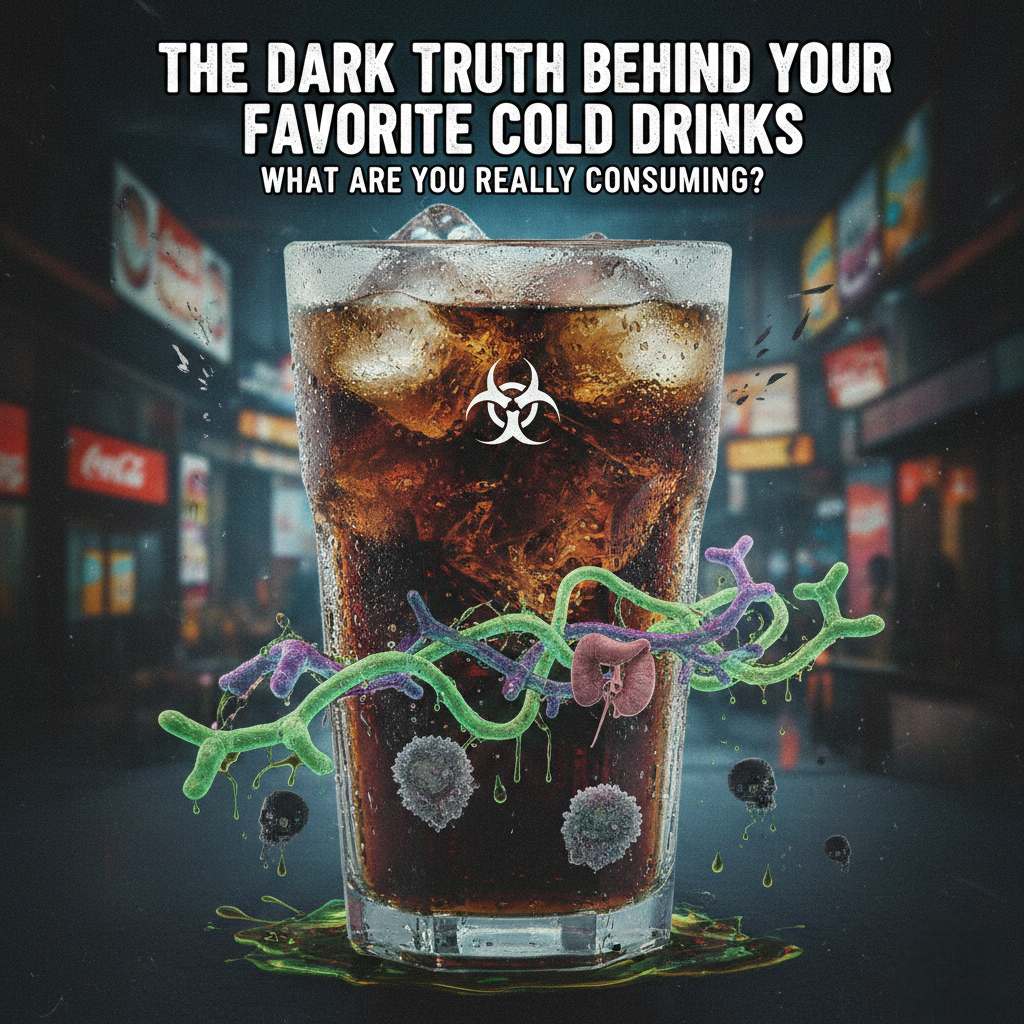
Soft drinks have seamlessly infiltrated our daily lives. Whether you are at a cinema hall, a cricket match, a college canteen, or a wedding, you will see people of all ages—from young children to senior citizens—holding a bottle. In fact, Coca-Cola is sold everywhere on the globe except for two countries: North Korea and Cuba. With 1.9 billion servings of Coca-Cola sold daily worldwide, the sheer volume of consumption is unimaginable. Today, I want to shock you by breaking down exactly what you are putting into your body every time you open one of these bottles, so you can finally know the dark truth behind these beverages.
Busting the Toilet Cleaner Myth Before we get into the real dangers, I want to expose these drinks using absolute facts, which means clearing up a massive piece of misinformation first. Critics frequently claim that sodas like Pepsi and Coca-Cola are equivalent to “toilet cleaners”. The direct answer to this comparison is an absolute NO.
People make this claim because both soft drinks and toilet cleaners contain acids. However, chemistry is complex, and deriving conclusions based on a single common constituent is terrible science. Soft drinks use mild, food-grade acids like naturally-occurring citric acid (also found in lemons) and phosphoric acid. Phosphoric acid, officially listed as Food Grade Additive E338, is safely used in jams, processed meats, baking powder, and cheese to prevent the growth of bacteria and mould in high-sugar environments. Conversely, toilet cleaners use highly concentrated, harsh chemicals like Sodium Hypochlorite and Hydrochloric Acid to scrub away tough stains.
People also argue that the pH level (acidity) of a soft drink matches that of a toilet cleaner. While a soft drink has a pH around 2.5, natural lemon juice sits between 2.0 and 2.6, and pomegranates are around 2.9. We obviously wouldn’t call a lemon a toilet cleaner. So, if this myth is false, does that mean soft drinks are perfectly safe to consume? Absolutely not.
Assuming we are talking about an unaltered bottle completely free of accidental contaminations—like the massive pesticide scandals in Delhi in 2004, 2006, and 2016—the intended ingredients alone are enough to destroy your health. Let’s look at the label.
The Illusion of Empty Calories
If we look at major competitors like PepsiCo’s Mirinda or Coca-Cola’s Fanta, the label reads 55 calories per 100ml. In a standard 600ml bottle, that equates to a massive 330 calories. To put this into perspective, 330 calories is equivalent to eating two oil-fried aloo parathas or devouring a whole masala dosa accompanied by sambar and coconut chutney.
The problem is that a plate of parathas or dosas serves as a full lunch that satisfies your hunger and provides essential nutrients like protein, sodium, potassium, vitamins, and fibers. A bottle of soda provides absolutely zero nutrients. It offers nothing but “empty calories”. After drinking it, your hunger remains completely unsoothed, meaning you still have to eat a full lunch or dinner on top of those 330 liquid calories.
The Sugar Overdose and Addiction
All of those empty calories come directly from sugar. A soft drink like Mirinda packs 13.8 grams of sugar per 100ml. Multiply that by six for a 600ml bottle, and you are drinking 82.8 grams of sugar.
How much added sugar does a human body actually need to function properly? The American Heart Association clearly states that our bodies require exactly 0 grams of added sugar. We get all the energy we need from natural sugars, like the lactose found in milk or the fructose found in fresh fruits. Even so, if we look at the absolute maximum limit our bodies can safely tolerate, it is 36 grams a day for an adult man and 25 grams a day for an adult woman. A single 600ml bottle forces you to consume more than double or triple your daily recommended limit.
Doing this once or twice won’t cause instant consequences, but making it a daily habit will eventually make you incredibly sick. Beyond just obesity, regular excessive sugar intake causes severe, lesser-known ailments: severe joint pain, accelerated skin aging, liver damage, Type 2 diabetes, pancreatic breakdowns, kidney failure, and a heavily increased risk of a heart attack.
The most terrifying part is that sugar is highly addictive. A 2017 study even compared sugar addiction to cocaine addiction. This is exactly why you rarely find a person who drinks soda just once every 3 to 4 months. Those addicted to it either consume soft drinks regularly, or they constantly satisfy their cravings with high-sugar chocolates, candies, and ice creams.
The Deception of Diet Drinks
Because of growing global awareness regarding sugar overdoses, companies launched Diet Pepsi in 1964 and Diet Coke in 1982. These diet drinks boast 0 calories and 0 added sugar, but they achieve their sweetness using artificial sweeteners like aspartame, saccharin, or sucralose.
Are these safe? Far from it. Artificial sweeteners carry a highly controversial history. A recent French study conducted on March 24, 2022, monitored 100,000 adults over 7 to 8 years and discovered that aspartame significantly increases the risk of cancer. The official website of the Center for Science in the Public Interest (CSPI) also links aspartame to cancer. Other major studies have linked these artificial sweeteners to heart disease, strokes, diabetes, kidney and liver toxicity, mental health problems, and even severe birth defects.
Toxic Colors: Carcinogens in Your Cup
If we give artificial sweeteners the benefit of the doubt, the rest of the ingredients are still horrifying. Let’s examine what gives Pepsi and Coca-Cola their iconic dark brown and black color: Caramel.
This isn’t the natural caramel you make at home. It is burnt sugar processed with ammonia and sulphites, which releases a highly toxic byproduct called 4-MI (4-Methylimidazole). Several studies link 4-MI to cancer, and the state of California officially lists it as a carcinogen with a legal allowable limit of just 29 micrograms. Shockingly, news articles in 2012 revealed that samples of these soft drinks contained 138 micrograms of 4-MI—more than four times the permitted safety limit.
When this controversy erupted, Coca-Cola changed its formula to lower 4-MI levels, but they only did this in America. They continued to exploit loopholes in developing countries like India, continuing to sell the dangerous, cancer-causing formula there, as confirmed by further testing in 2014. (As a brief warning: burning any food beyond a certain point, like blackened toast or overly charred vegetables, introduces high levels of Acrylamide, which the World Health Organization labels as a probable human carcinogen. Do not eat excessively burnt food!).
If you drink orange beverages like Mirinda or Fanta, you aren’t safe either. Their bright orange color comes from a synthetic, petroleum-based Azo Dye known by the code name E110, or Sunset Yellow FCF (chemical name: disodium 2-hydroxy-1-(4-sulfonatophenylazo)naphthalene-6-sulfonate). Decades ago, in 1973, a pediatric researcher named Benjamin Feingold linked these artificial flavors to severe hyperactivity and attention span deficits in children.
Because of these dangers, progressive countries like Norway, Finland, and Sweden completely banned E110 in the year 2000. Following a 2007 study by Southampton University confirming links to childhood hyperactivity, the UK Food Standards Agency pushed for a broader ban. By 2010, the European Union implemented strict regulations forcing any product containing these colors to carry a warning label stating they may cause adverse effects on children’s activity and attention. Due to the new labels, companies stopped using E110 in the EU. However, if you turn around a bottle of Mirinda in India today, you will still see “Contains permitted synthetic food colour (110)” proudly printed on the back.
Why does this double standard exist? Because companies like PepsiCo spend millions on lobbying—essentially legalized corruption—paying political parties to secure rulings that favor their profits. In America alone, PepsiCo spent $3.6 million on lobbying. In developing countries lacking stringent health regulations, they continue to sell cheap, toxic, and potentially cancer-causing products completely unchecked.
Dangerous Preservatives and Exhaust Fumes
The nightmare continues with Preservative E211, the code name for Sodium Benzoate. In 2005, private lab tests conducted by the US FDA discovered Benzene inside soft drinks. Benzene is a highly toxic, cancer-causing gas normally emitted from the exhaust pipes of vehicles burning petrol and coal.
How does vehicle exhaust end up in your drink? Researchers discovered that when the preservative Sodium Benzoate (E211) is mixed with Ascorbic Acid (Vitamin C) and exposed to basic heat and light, a chemical reaction occurs that directly forms Benzene inside the bottle. Following massive lawsuits in 2007, Coca-Cola announced in 2008 that they would remove Sodium Benzoate from their soft drinks—but once again, they only did this in the countries where they were being actively sued. In India, it remains a heavily used preservative. To make matters worse, excessive sodium intake from these preservatives directly leads to hypertension.
Acidity Regulators, Stabilizers, and Damaged Teeth
Let’s not forget the Phosphoric Acid we discussed earlier. While it halts bacteria, consuming the massive amounts present in sodas aggressively strips the enamel from your teeth, leading to severe dental corrosion (which is exactly why dentists warn children against soda).
To finish off the chemical cocktail, companies add Acidity Regulators like 330 (Citric Acid) to artificially inject a sour taste, and 331 (Sodium Citrate) to reduce acidity and prevent the drink from oxidizing. They also dump in Stabilizers and Emulsifiers—like E1450 (Starch Sodium Octenyl Succinate) and E445 (Ester Gum)—which simply ensure the liquids mix together perfectly and remain homogenous without forming any unappealing lumps. Finally, the entire mixture is dumped into carbonated water—water artificially infused with carbon dioxide gas to create the “fizz”.
The Corporate Playbook and The Final Solution
In essence, a soft drink is just water heavily infused with carbon dioxide, lethal amounts of sugar, cancer-linked artificial colors (like 4-MI Caramel or Sunset Yellow E110), toxic preservatives (like Sodium Benzoate), and chemical stabilizers. A concoction guaranteed to drastically increase your risk of obesity, diabetes, osteoporosis, dental corrosion, hypertension, and potentially cancer.
Knowing all of this, who would logically choose to drink it?. Beverage companies know this, which is why they actively target youth. Despite a joint 2014 pledge by Coca-Cola, PepsiCo, McDonald’s, and Kellogg’s promising not to market to children under 12, they continue rampant indirect marketing by featuring kids in their TV ads and sponsoring school cricket tournaments and quizzes.
If you are telling yourself you can moderate your intake and only drink a soda once every few months, you are lying to yourself. Sugar addiction is powerful, and a few months will quickly slip into a few weeks, dragging you right back to daily consumption. You must actively fight this addiction.
Do not be fooled into thinking fresh fruit juices or lemonades are safe alternatives. While they lack synthetic dyes and toxic preservatives, they still contain massive, dangerous amounts of sugar. Lemonades are packed with added sugars, and fresh juices are highly concentrated. Drinking a single small glass of fresh orange juice forces you to consume the concentrated natural fructose of 6 to 10 whole oranges at once, skyrocketing your sugar intake to highly unhealthy levels.
The ultimate solution is profoundly simple: banish cold drinks, fruit juices, and lemonades from your life entirely, and just drink water. The next time you order a pizza or a burger, completely ignore the soda menu and ask for plain tap water.
I am telling you the absolute truth: it only takes a few weeks for your taste buds to adapt to a low-sugar lifestyle. Once you overcome the initial cravings, you will naturally stop liking excessively sweet things. Water will effortlessly become your preferred choice. I urge you to make this life-saving change today, and share this information with everyone you care about so they can protect their health too