
You’re sitting right now.
Maybe you’re hunched over your laptop. Maybe your shoulders are creeping up toward your ears. Maybe your lower back is screaming but you’re ignoring it.
And you wonder why you can’t focus.
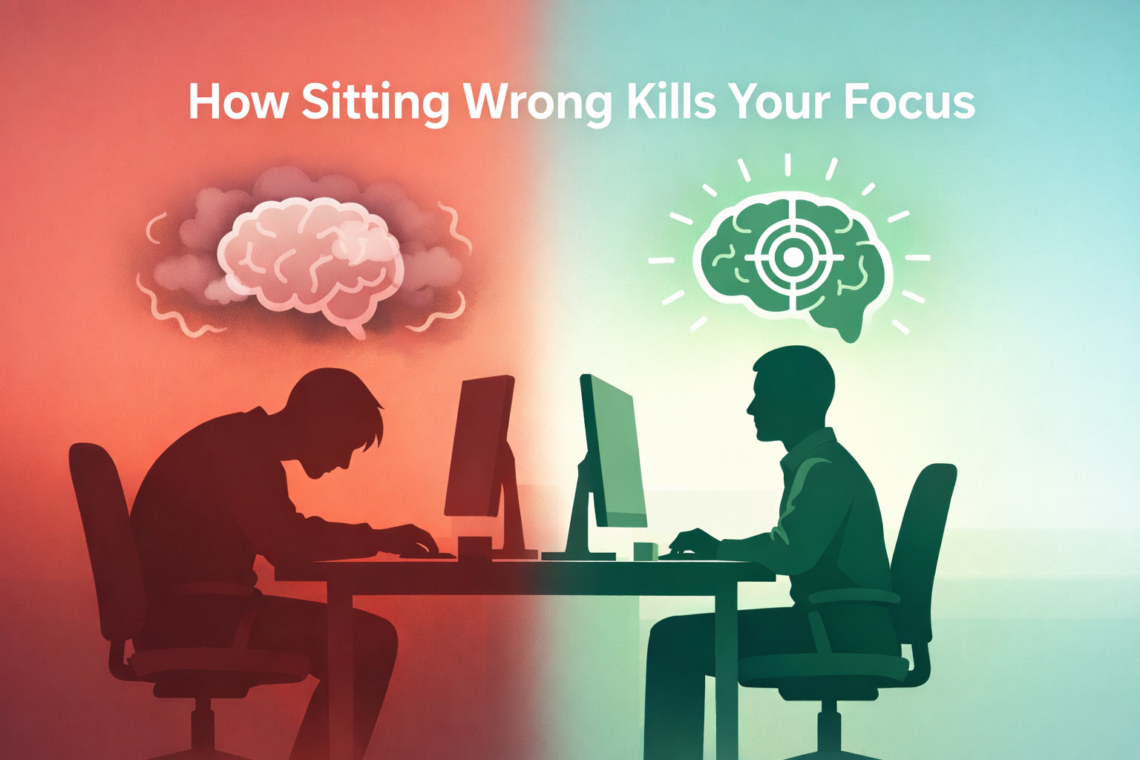
Here’s the truth nobody talks about: Your posture isn’t just about back pain. It’s about brain power.
When you sit poorly, you’re not just hurting your spine. You’re sabotaging your concentration, draining your energy, and slowing down your thinking.
Science confirms it. And the fix is simpler than you think.
This isn’t about buying a ₹50,000 ergonomic chair. It’s about small, science-backed tweaks you can make right now—wherever you work.
Let’s fix your posture. And unlock your focus by learning how posture-productivity linked with each other.
How posture affects concentration and productivity (Posture-Productivity Link)
Let’s start with the science.

Your brain and your body aren’t separate. They’re in constant conversation. And your posture is one of the loudest voices in that conversation.
The Brain-Body Connection

When you slouch:
- Your chest compresses → less oxygen reaches your brain
- Your neck strains → blood flow to the brain reduces
- Your core disengages → your nervous system stays in “alert” mode
Result? Brain fog. Fatigue. Poor focus.
A study published in Applied Ergonomics found that participants who sat with upright posture showed:
- 15% better performance on cognitive tasks
- Higher alertness and lower mental fatigue
- Improved mood and confidence
Another study in Health Psychology Report showed that upright posture increased positive affect and reduced fear during stress tasks.
Your body language doesn’t just reflect your mindset. It shapes it.
The Remote Work Reality
If you work from home, this matters even more.
Without a structured office setup, it’s easy to:
- Work from your bed (hello, neck strain)
- Slouch on the couch (goodbye, lumbar support)
- Hunch over a laptop for hours (see ya, shoulder tension)
A 2023 survey by Buffer found that 22% of remote workers struggle with physical health issues related to their workspace—posture being a top complaint.
Poor posture isn’t a “someday” problem. It’s a right-now productivity killer.
The science behind posture and brain function (Posture-Productivity Link)
Let’s go deeper. Why does sitting up straight actually help you think better?
1. Oxygen Flow = Brain Fuel
Your brain uses about 20% of your body’s oxygen. When you slouch, you compress your lungs. Less air in = less fuel for your neurons.
Upright posture opens your chest. Better breathing. Better focus.
2. Spinal Alignment = Nervous System Calm
Your spine houses your central nervous system. When it’s misaligned:
- Nerve signals get disrupted
- Stress hormones (like cortisol) can increase
- Your body stays in low-grade “fight or flight”
Good posture = calm nervous system = clearer thinking.
3. Body Language Shapes Mindset
Research from Social Psychological and Personality Science shows that “power posing” (open, upright posture) can:
- Increase feelings of confidence
- Reduce stress reactivity
- Improve performance under pressure
You don’t need to fake it. Just sit like someone who believes they can handle the task.
“Stand up straight with your shoulders back.” — Jordan Peterson (controversial, but the biology checks out)
3 Simple posture fixes you can do today (no gear required)
You don’t need a standing desk. You don’t need a posture corrector. You just need awareness + action.
Here are 3 research-backed fixes you can start right now.
🔹 Fix #1: The 90-90-90 Rule (Desk Setup in 30 Seconds)
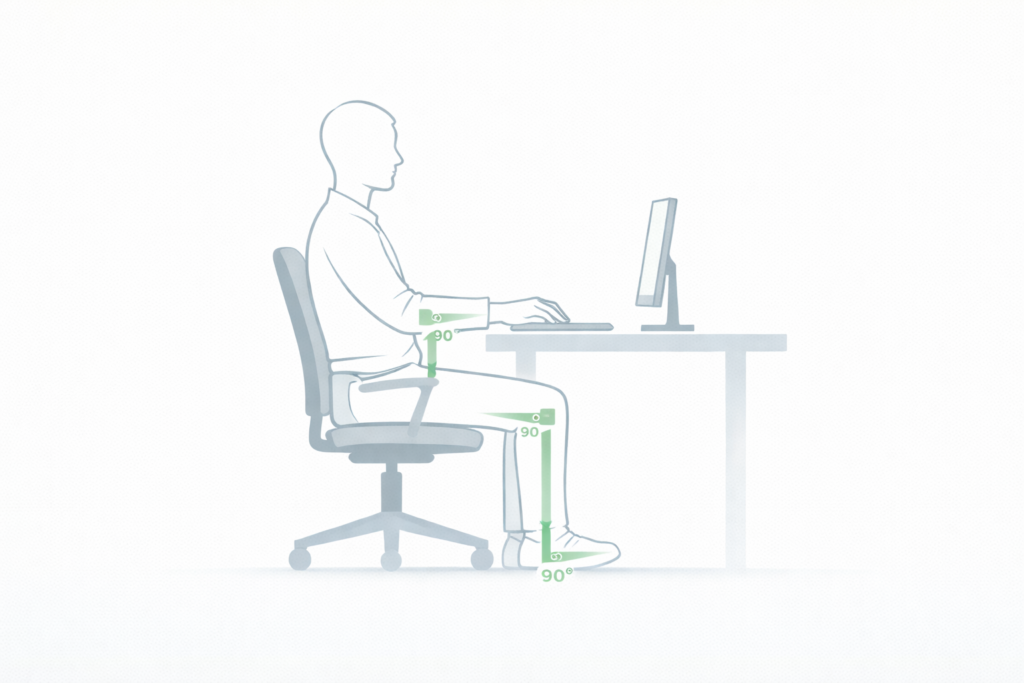
This is your instant ergonomic audit.
Sit at your desk and check:
- Feet flat on floor (or on a footrest) → 90° at ankles
- Knees at 90° → thighs parallel to floor
- Elbows at 90° → forearms parallel to desk, wrists straight
Why it works: This alignment reduces strain on your spine, shoulders, and wrists. It’s the foundation of sustainable sitting.
Pro tip: If your chair is too high, use a stack of books as a footrest. If your screen is too low, prop your laptop on a box.
🔹 Fix #2: The Chin Tuck + Shoulder Reset (60 Seconds)
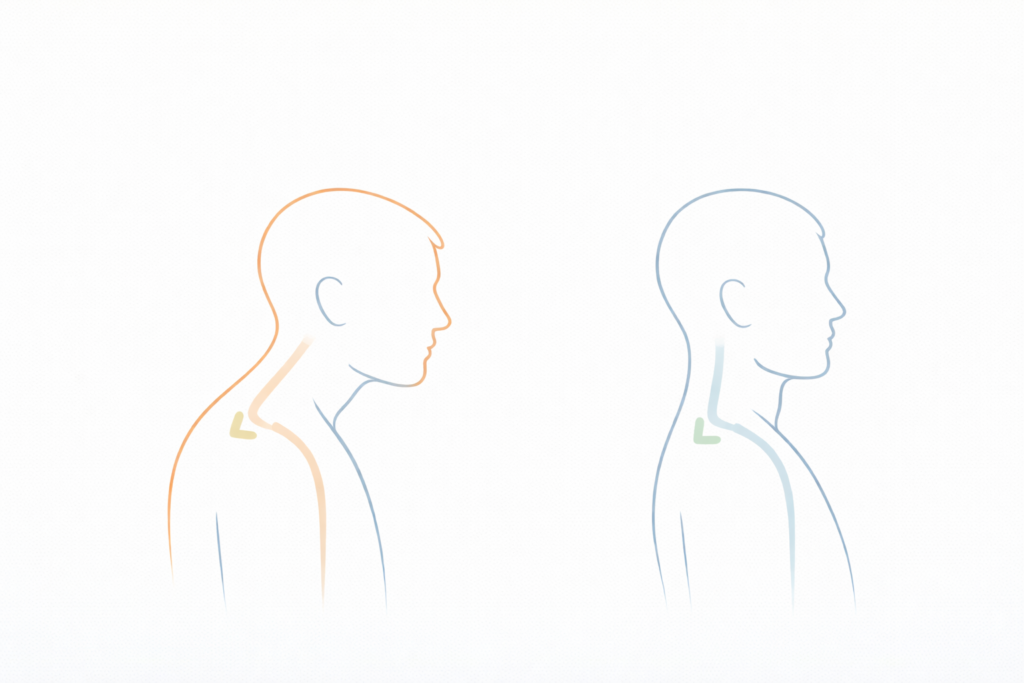
Do this every hour.
- Chin Tuck: Gently pull your chin straight back (like making a “double chin”). Hold 3 seconds. Release. Repeat 3x.
- Shoulder Reset: Roll shoulders up, back, and down in one smooth motion. Repeat 5x.
Why it works: This reverses “tech neck” (forward head posture) and releases tension in your upper back. It takes less than a minute and instantly improves alignment.
Bonus: Do this before important calls or deep work sessions. You’ll feel more alert.
🔹 Fix #3: The 20-20-20 Posture Break (Every 20 Minutes)
You know the 20-20-20 rule for eyes? Let’s upgrade it.
Every 20 minutes:
- Look at something 20 feet away for 20 seconds (eye rest)
- AND reset your posture: sit tall, feet flat, shoulders relaxed
- Take one deep breath into your belly
Why it works: This combats both eye strain AND postural drift. It’s a full-system reset that takes 30 seconds.
Set a silent timer or use a free app like Stretchly or Time Out to remind you.
Real-life examples: Posture fixes that changed workdays (Posture-Productivity Link)
This isn’t theory. Real people use these tweaks with real results.
Ananya, 26, Content Writer (Bangalore)
“I used to work from my bed. By 3 PM, I’d have a headache and zero focus. I tried the 90-90-90 rule at my dining table. Within a week, my afternoon slump disappeared. Now I get more done in 4 hours than I used to in 8.”
Rohan, 31, Software Developer (Remote)
“My shoulders were always tight. I started doing the chin tuck every hour. First day: felt silly. First week: noticed less neck pain. First month: my code reviews got faster because I could focus longer.”
Priya, 22, Student (Online Classes)
“I’d slouch during lectures and zone out. The 20-20-20 posture break changed everything. I’m more present in class, and I remember more. My grades improved—not from studying more, but from focusing better.”
These stories aren’t about perfection. They’re about small shifts that compound.
Common posture mistakes that kill focus (and how to avoid them)
Even with good intentions, it’s easy to slip up. Watch for these traps:
❌ The Laptop Hunch
Looking down at a laptop strains your neck.
✅ Fix: Raise your screen to eye level (use books, a stand, or a separate monitor).
❌ The Couch Crawl
Working from the sofa feels cozy but wrecks your spine.
✅ Fix: Reserve the couch for rest. Use a proper chair for work—even if it’s just a dining chair with a cushion.
❌ The Static Sit
Sitting “perfectly” for hours isn’t the goal. Movement is.
✅ Fix: Change positions often. Stand, stretch, walk. Your best posture is your next posture.
❌ Ignoring Your Phone
Scrolling with your head down adds hours of strain.
✅ Fix: Hold your phone at eye level. Yes, it feels weird. Yes, it helps.
❌ Waiting for Pain to Act
Don’t wait until your back hurts to fix your posture.
✅ Fix: Start today. Prevention is easier than correction.
✅ Golden Rule: Comfort ≠ Support. A soft couch feels nice but doesn’t support your spine. A firm chair with good alignment does.
When to consider professional help (and when you don’t need it)
Most posture issues improve with simple habits. But see a professional if you notice:
- Persistent pain that doesn’t improve with posture tweaks
- Numbness, tingling, or weakness in arms/hands
- Headaches that start at your neck and radiate upward
- Difficulty breathing or chest tightness when sitting
These could signal underlying issues like herniated discs or nerve compression—best evaluated by a physiotherapist or doctor.
This article is for educational purposes only and is not medical advice. Always consult a qualified healthcare professional for personal health concerns.
For most people, though, the fixes above are enough. Start small. Stay consistent. Your body will thank you.
Conclusion: Sit Better. Think Clearer. Work Smarter.

Your posture isn’t just about looking confident.
It’s about feeling focused. It’s about having the energy to finish what you start. It’s about giving your brain the physical support it needs to do its best work.
You don’t need a perfect setup. You don’t need to sit like a statue.
You just need to start.
Try one fix today:
- Set up the 90-90-90 rule at your desk
- Do the chin tuck right now
- Set a 20-minute timer for your next posture break
Small shifts. Big impact.
Your focus is waiting. Sit up and meet it.
Frequently Asked Questions (FAQs)
Q: Can poor posture really affect my mood?
A: Yes. Research shows upright posture can increase positive emotions and reduce stress reactivity. Your body and mind are connected.
Q: How long does it take to see improvement?
A: Many people notice less tension and better focus within days. Long-term postural changes take weeks of consistent practice.
Q: Do posture correctors work?
A: They can raise awareness short-term, but they don’t build strength. Focus on muscle engagement and habit changes for lasting results.
Q: What if I have back pain already?
A: Start gently. Try the chin tuck and shoulder reset. If pain persists, consult a physiotherapist for personalized guidance.
Q: Can I fix my posture while standing or walking?
A: Absolutely. The same principles apply: ears over shoulders, shoulders over hips, engaged core. Practice mindful walking.
Also Read:
“Struggling to focus? Try our guide to the hidden power of boredom
“Build better habits with our framework for breaking big goals into small steps
“Improve your rest with our tips on why sleep quality matters