Imagine a university where an AI system doesn’t just answer questions—it proactively reaches out to a struggling student before they even know they’re falling behind, schedules their tutoring session, contacts their academic advisor, and adjusts their course load—all without a single human issuing a command. This isn’t science fiction. It’s happening now.
In 2026, artificial intelligence has moved from being a set of experimental tools to the core operating infrastructure of higher education . The shift is being driven by a new generation of technology called “agentic AI” —autonomous systems capable of planning, executing, and optimizing complex tasks without direct human supervision . As colleges face the “demographic cliff,” crushing financial pressures, and growing demands for workforce relevance, agentic AI is emerging as both a survival strategy and a transformation engine.
This article explores how autonomous AI systems are reshaping every corner of campus—from recruitment and advising to back-office operations and even the classroom itself.
What Is Agentic AI? Understanding the “AI Colleague”
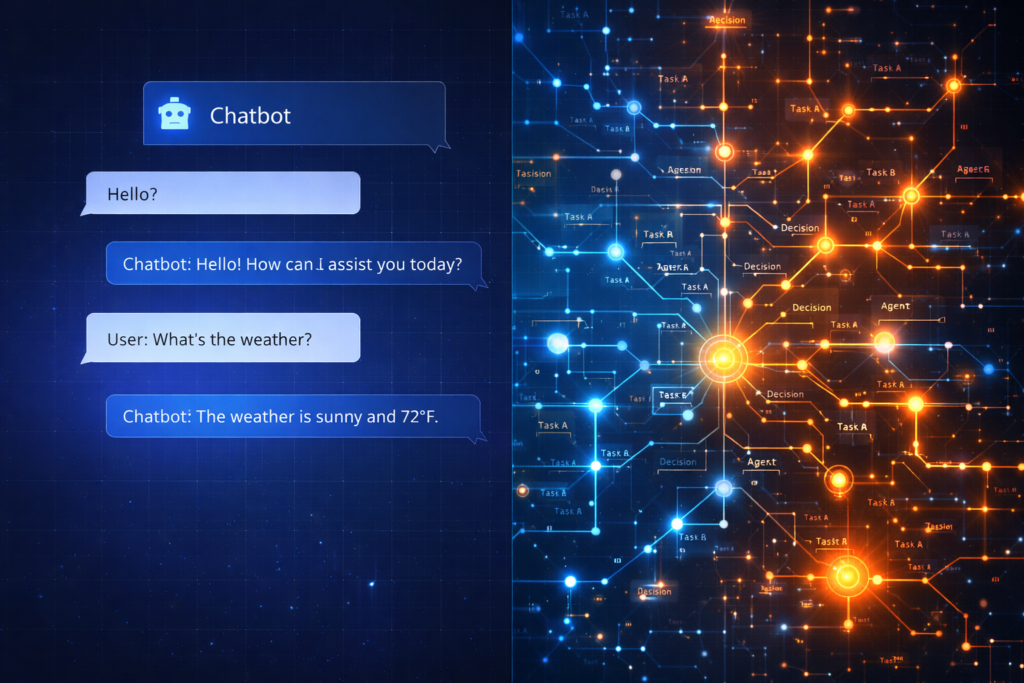
Before diving into how colleges are changing, it’s essential to understand what agentic AI actually is—and why it’s different from the chatbots and generative AI tools you’ve used before.
Agentic AI refers to AI systems that are capable of reasoned assessment, goal alignment, and autonomous task execution. Unlike a standard chatbot that responds to queries, an agentic AI can :
- Assess what’s needed to accomplish a goal
- Align a series of stacked tasks in logical sequence
- Complete those tasks without direct supervision
- Collect and analyze data along the way
- Document findings and optimize future performance
Think of it this way: if traditional AI is a helpful assistant who answers when you call, agentic AI is a proactive colleague who anticipates what needs to be done and handles it independently . As Ray Schroeder, Professor Emeritus at the University of Illinois Springfield, explains: “Agentic AI is no longer merely an interactive tool we talk to; it is a colleague that acts for us” .
The UPCEA 2026 Predictions Report frames this shift as a fundamental transition: “AI will move from a set of tools to the core operating infrastructure of higher education” . This means agentic systems will soon underpin everything from admissions to accreditation.
The 24/7 Digital Concierge: How Agentic AI Is Transforming Student Recruitment
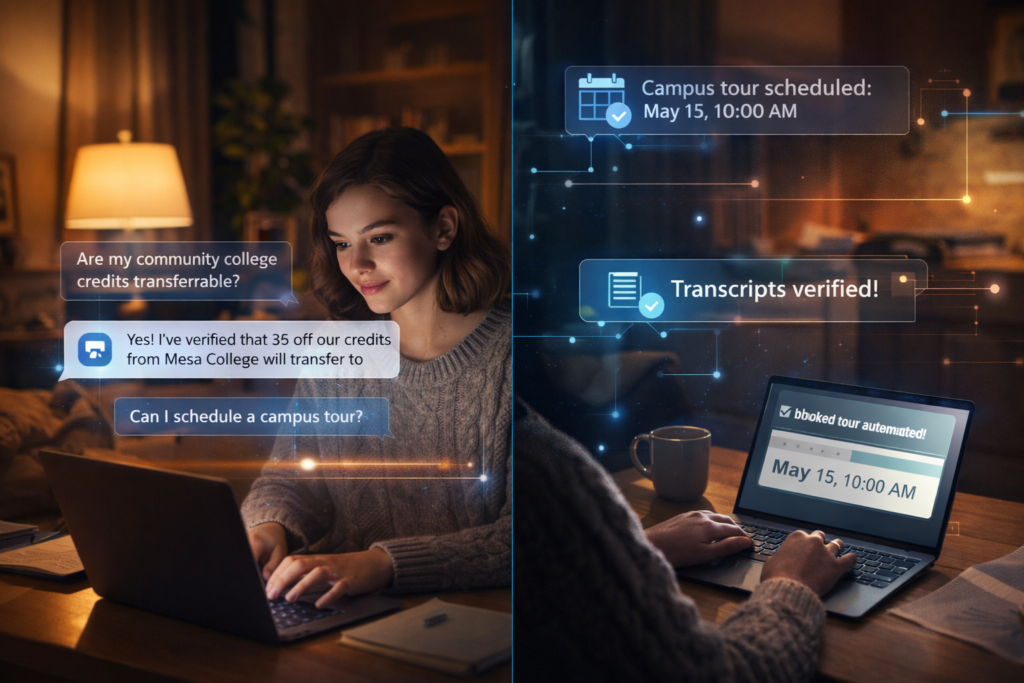
The first place students encounter agentic AI is often before they even apply. Recruitment has been transformed by autonomous systems that act as 24/7 digital concierges .
These agents go far beyond answering frequently asked questions. They now manage the entire “nurturing funnel”—the process of building relationships with prospective students over weeks and months. Modern recruitment agents can :
- Handle complex credit transfer evaluations automatically
- Schedule campus tours via multichannel SMS and web interfaces
- Personalize follow-up communications based on student interests
- Track engagement and adjust outreach strategies in real time
For international students, the impact is even more dramatic. Admissions document verification agents now autonomously verify international credentials, flag missing forms, and check for eligibility in milliseconds—reducing decision times from weeks to minutes . This speed and efficiency creates competitive advantages for institutions that adopt early, while widening the gap between well-resourced and resource-constrained colleges .
The shift also changes how students find programs in the first place. AI-driven search has become a gatekeeper of program visibility. Institutions must now optimize for “search everywhere optimization” (GEO/AEO) to ensure they appear in AI-generated best-of lists and voice-search results on platforms like TikTok and Reddit . Structured, transparent data is no longer optional—it’s essential for survival in an AI-mediated marketplace .
Socratic Tutors and Mental Health First Responders: AI in Student Support
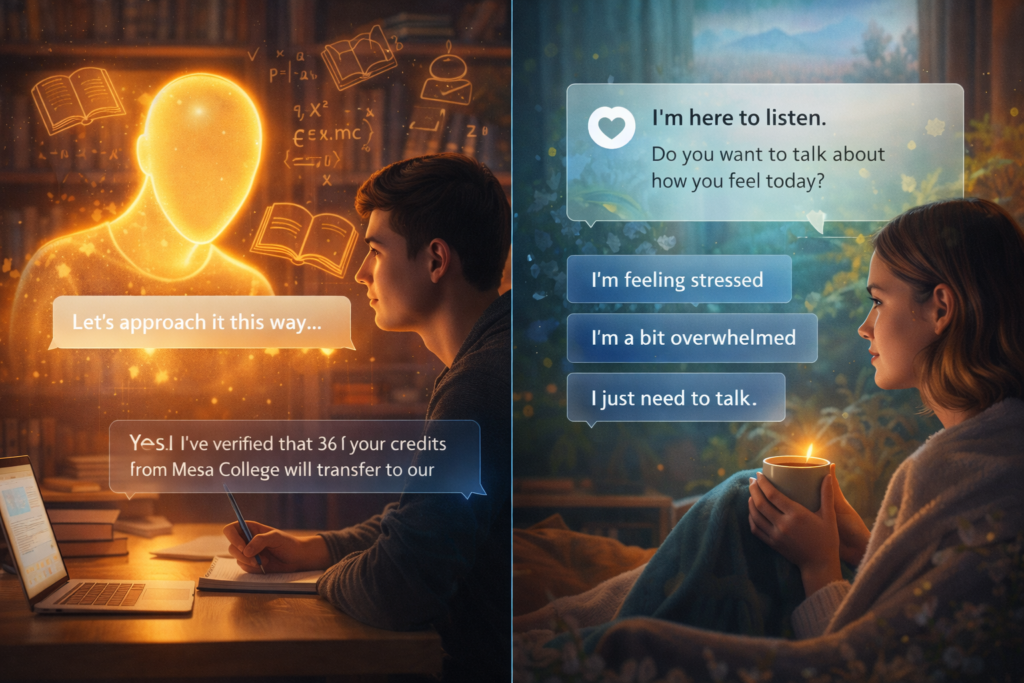
Once students arrive on campus, agentic AI meets them in multiple forms designed to support their academic journey and personal wellbeing.
Socratic tutors represent a leap forward in AI-powered learning. Unlike simple answer-bots, these agents engage students in genuine dialogue, scaffolding difficult concepts and generating infinite practice problems based on real-time course performance . Research from the University of Kassel found that dialogic, theory-informed AI tutors can actually foster critical and reflective thinking rather than replace it . When compared to conventional, non-dialogic feedback tools, Socratic approaches helped students develop deeper understanding, particularly in complex tasks like research question generation .
At the University of Hong Kong, a multi-agent AI chatbot now serves courses across Electrical Engineering, Philosophy, and Biomedical Sciences. The system features specialized agents—including an “administrative agent” and a “student analyzer agent“—that efficiently direct inquiries to appropriate resources while maintaining a knowledge base that reflects instructors’ own insights .
Perhaps most remarkably, agentic AI is now serving as mental health first responders. These agents act as low-barrier triage points, offering immediate coping strategies for anxiety and seamlessly escalating high-risk cases to human counselors . This doesn’t replace human mental health professionals—it extends their reach, ensuring that more students get timely support when they need it most.
Seneca Polytechnic in Canada has implemented “My Tutor,” an AI learning companion used across courses, alongside AI-powered tools that help students prepare for presentations, job searches, and interviews . All students and employees also have access to Microsoft 365 Copilot chat, embedding AI assistance into daily academic life .
Predictive Analytics: Catching Struggling Students Before They Fail
One of agentic AI’s most powerful applications is its ability to identify at-risk students before traditional warning signs appear. Using “behavioral trace data” from Learning Management Systems (LMS), predictive agents can identify students struggling in high-risk introductory courses—like College Algebra or General Chemistry—well before the first midterm .
This represents a fundamental shift from reactive to proactive student support. Rather than waiting for students to fail and then offering help, institutions can intervene early with targeted resources, tutoring, or advising. Retention has become “the defining enrollment metric” as campuses adopt AI-informed advising and proactive coaching models . The demographic cliff means colleges can no longer afford to lose students they’ve already recruited—and agentic AI is becoming essential to keeping them enrolled .
The Invisible Workforce: Agentic AI in Back-Office Operations
While student-facing applications get the most attention, some of agentic AI’s deepest impacts are happening where students never see—in the administrative back offices that keep universities running.
Finance and accounting have been transformed by autonomous agents handling invoice processing, general ledger coding, and “smart” expense management—all while ensuring policy compliance without manual data entry . Procurement agents continuously monitor contract compliance and supplier health, identifying hidden savings that can be reallocated directly to student scholarships .
Grant management has become dramatically more efficient. AI agents now scan federal databases like Grants.gov to match faculty research with funding opportunities, draft initial narratives, and manage post-award financial reporting . This frees faculty from administrative burdens and increases the likelihood of securing competitive funding.
Regulatory reporting and audit agents autogenerate audit-ready reports for state and federal compliance, reducing the administrative burden on institutional research offices . With new accountability frameworks like Gainful Employment and Financial Value Transparency taking full effect in 2026, this capability has moved from convenience to necessity .
Human resources has been transformed by 24/7 staff-facing agents that answer complex questions about leave policies, payroll, and benefits—freeing HR professionals for strategic culture-building work rather than repetitive inquiries .
The cumulative effect is significant cost and time efficiency. As Schroeder notes, this opens the possibility that “portions of individual position descriptions can be offloaded from humans and integrated into agentic AI duties,” resulting in fewer overall employees and lower indirect costs . This doesn’t necessarily mean mass layoffs, but it does mean roles are evolving—and professionals must adapt.
How Teaching Is Changing: Faculty Roles in the Agentic Age
Perhaps the most sensitive question surrounding agentic AI is what it means for faculty. Will professors be replaced? The emerging evidence suggests a more nuanced picture: faculty roles are evolving, not disappearing.
A massive 2026 study from UC Berkeley’s Center for Studies in Higher Education analyzed over 31,000 course syllabi from 2021 to 2025, tracking how faculty responded to AI’s rise . The findings reveal a significant shift: instructors are moving away from blanket bans toward “task-based” approaches that differentiate where AI can support learning and where it might undermine skill formation .
- Faculty are warming toward AI: Initial restrictive policies are giving way to more permissive approaches
- Stark disciplinary differences: Business courses have moved fastest toward permissive policies (27% now include AI-based assignments), while humanities remain most restrictive
- Course task composition predicts regulation: Courses requiring more writing and coding—areas where AI capabilities are strong—are significantly more likely to have explicit AI policies
This suggests that effective institutional AI policies require flexibility to accommodate disciplinary differences. It also highlights a potential feedback loop between education and labor markets: if AI displaces skill-building tasks, students may graduate with weaker skills in precisely the areas where AI is strongest .
The concept of “AI fluency” as a graduation standard is gaining traction. Rather than focusing solely on academic integrity, forward-thinking institutions are redesigning curricula to ensure students graduate with the ability to understand, apply, and critically evaluate AI tools . This represents a fundamental shift in what it means to be an educated person in the 21st century.
Some experts predict that AI-led instruction is inevitable, particularly in noncredit offerings, but that ultimately “no teaching task will be out of reach” . The opportunity lies not in replacement but in augmentation—freeing faculty to focus on mentorship, complex dialogue, and the human connections that machines cannot replicate.
Why Now? The Perfect Storm Driving AI Adoption in Higher Education
Agentic AI isn’t transforming colleges in isolation. It’s one element of a perfect storm of pressures that make 2026 a watershed year for higher education.
The demographic cliff is deepening. Fewer traditional-aged students means colleges must compete more aggressively for a shrinking pool, while increasingly relying on the “New Majority” of adult, working, part-time, and returning learners . Retention has become the defining metric, and AI-informed advising is essential to keeping students enrolled .
Financial pressures are intensifying. Competition in online education is growing, benefiting students but widening the gap between well-resourced and resource-constrained institutions . Agentic AI offers a path to cost efficiency that many colleges cannot afford to ignore.
Policy and accountability demands are escalating. The full implementation of Gainful Employment and Financial Value Transparency frameworks has ushered in an era of heightened accountability . Workforce Pell is expanding access to short-term training, and federal and state policy increasingly mandates interoperability, stackability, and alignment with labor-market needs. Institutions must demonstrate value in ways that were never required before.
Workforce expectations are shifting rapidly. Employers increasingly value skills over credentials, and blended ecosystems of digital badges, Credit for Prior Learning (CPL), and stackable credentials are blurring boundaries between academic and professional learning . Agentic AI enables institutions to offer the personalized, flexible pathways that today’s learners demand.
AI itself is maturing. The technology has reached a point where enterprise-wide deployment is feasible and cost-effective. As one analyst notes, institutions are moving “from scattered pilots to governed, agentic workflows that will define the next decade of ensuring student success and operational efficiency” .
Ethical Challenges and the “Pedagogy of Hope”
With great power comes great responsibility, and agentic AI raises profound ethical questions that colleges must address.
A 2026 study from the University of Jaén introduced the concept of “Nested Learning” —a neuro-adaptive ecosystem design in which AI agents orchestrate instructional support while preserving student agency and a “pedagogy of hope” . The research identified recurring concerns among students and faculty about privacy and “cognitive sovereignty” —the right to control one’s own mental processes and data .
Key ethical considerations include :
- Data privacy: Who owns the vast amounts of behavioral data AI systems collect?
- Algorithmic bias: Are agentic systems perpetuating or reducing existing inequities?
- Transparency: Can students and faculty understand how and why AI makes decisions?
- Human agency: Are we designing systems that empower humans or replace them?
- Accountability: Who is responsible when an autonomous system makes a mistake?
The UPCEA predictions emphasize that institutions must adopt governed, transparent approaches to AI deployment . This means moving from experimentation to execution with clear ethical frameworks, faculty involvement, and student input. The institutions that thrive will be those that operationalize AI thoughtfully, not just quickly.
The “pedagogy of hope” framework reminds us that technology should serve human flourishing, not undermine it. As one researcher put it, the goal is to create ecosystems where students experience “clarity, adaptive support and non-punitive error culture” while maintaining robust protections for their cognitive autonomy .
What’s Next: The Future of the Agentic University
As 2026 unfolds, several trends will shape the continued evolution of agentic AI in higher education.
Integration, not isolation. AI will become embedded in everything institutions do, from strategic planning to daily operations. The distinction between “AI tools” and “core infrastructure” will disappear .
The rise of orchestrated multi-agent systems. Rather than single AI applications, institutions will deploy constellations of specialized agents that work together—an admissions agent, a financial aid agent, an academic advising agent, a mental health agent—all coordinated behind the scenes to support each student’s unique journey .
Faculty evolution, not extinction. The Berkeley syllabus study suggests that faculty are adapting in sophisticated ways, designing assessments that focus on process rather than product and teaching students to work critically with AI rather than around it . This trend will accelerate.
Workforce alignment deepens. As employers increasingly trust stackable credentials and competency-based hiring, agentic AI will enable institutions to offer the personalized, flexible pathways that working adults need .
Global competition intensifies. Institutions worldwide are investing in AI infrastructure. The gap between leaders and laggards will widen, with consequences for enrollment, reputation, and financial sustainability .
The Bottom Line
Agentic AI is not coming to higher education—it’s already here. In 2026, autonomous systems are handling admissions, advising students, supporting mental health, managing finances, and increasingly, shaping how teaching and learning happen. The institutions that thrive in this new landscape will be those that embrace AI not as a set of isolated tools but as core infrastructure—deployed thoughtfully, governed transparently, and designed to serve human flourishing rather than replace it.
For students, this means more personalized support, faster responses, and learning experiences adapted to their unique needs. For faculty, it means evolving roles and new opportunities to focus on what matters most. For administrators, it means difficult decisions about investment, ethics, and institutional identity.
The agentic university is rising. The only question is whether your institution will lead, follow, or be left behind.