
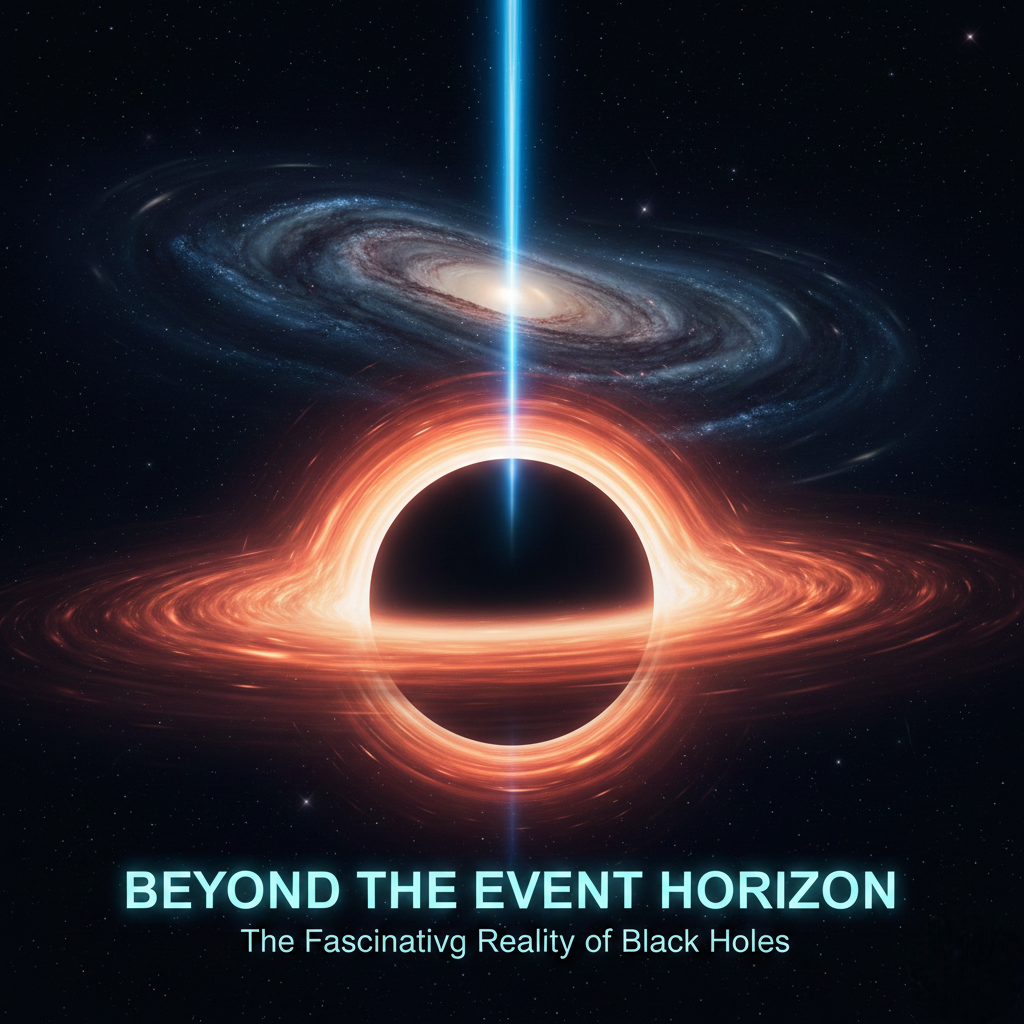
Black holes, Scientific theories of Albert Einstein. How celestial phenomena are formed from the collapse of massive stars and their various classifications, such as stellar and supermassive types. Key astronomical features including the accretion disk, the event horizon, and the mysterious singularity at the center where gravity becomes infinite. Furthermore, Exploreing the concept of gravitational time dilation, illustrating how extreme mass can warp the fabric of space-time and slow the passage of time. Finally, Contrasting theoretical physics with visual evidence, such as the first captured photograph of a black hole, to clarify common misconceptions about these powerful cosmic structures.
If you remember the 2014 blockbuster film Interstellar directed by Christopher Nolan, you might recall its scientifically accurate depiction of space concepts like wormholes and alien planets. However, the most shocking scene occurs at the climax when the main character, Cooper, falls into a massive black hole named Gargantua. Initially surrounded by complete darkness, Cooper soon notices grain-like particles hitting and scratching his spacecraft, eventually causing it to catch fire. After ejecting, he falls deeper and suddenly finds himself in a mind-boggling five-dimensional tesseract, a place where he can communicate with his past self using gravity. Seeing these scenes leaves us wondering: is this actually what happens inside a black hole? Today, let us take a detailed dive into the fascinating reality of black holes.
The Origins: Einstein and the Theory of Relativity Until the 20th century, black holes remained largely unknown. Their discovery is deeply rooted in Albert Einstein’s Theory of Relativity, which is divided into two distinct parts. The first is the Special Theory of Relativity, published in 1905, which introduced the concept of Kinematic Time Dilation. This theory explains that if you travel in a spaceship at incredibly high speeds, time will slow down for you relative to the people back on Earth, even though you wouldn’t personally feel the flow of time changing while inside the ship.
The second part is the General Theory of Relativity, developed in 1915, which demonstrated that not only speed but also gravity can cause time dilation. The stronger the gravitational force you experience, the more time slows down for you—a phenomenon known as Gravitational Time Dilation. Interstellar depicted this brilliantly when Cooper’s team landed on the Aqua Planet; because the planet was so dangerously close to the Gargantua black hole, its massive gravity caused one hour on the planet to equal seven years on Earth.
To visualize how gravity works, Einstein proposed the concept of a space-time fabric, functioning much like a flexible mesh. Planetary objects sit on this mesh, and their massive weight causes it to bend. This bending not only attracts physical objects but also slows down time and affects other forms of energy, including heat, sound, and light. Interestingly, Einstein theorized that gravity’s influence is not instantaneous everywhere; its absolute speed limit matches the speed of light. For example, if the Sun were to suddenly disappear, it would take exactly eight minutes for the Earth to lose its light, and exactly eight minutes for us to feel the gravitational impact of its disappearance.
Because gravity attracts light, Einstein’s theories implied that there could be objects in the universe with a gravitational pull so immense that they completely absorb light, rendering them entirely black and invisible. However, Einstein himself found the actual existence of black holes too weird to be realistic. He knew they worked in his theoretical math, but practically, he did not believe they existed. By the time he passed away, the term “Black Hole” had not even been invented yet. It was first used in a magazine in 1964 and popularized by physicist John Wheeler in 1967. Through complex equations derived from Einstein’s work, scientists in the 1960s finally agreed that black holes do realistically exist in space.
What is a Black Hole and How is it Formed?
The name “Black Hole” is somewhat misleading because it is not an actual empty hole in space. Black holes are regions in space where the force of gravity is so incredibly strong that not even light can escape, and they are formed by the deaths of stars, meaning there is highly condensed material at their center.
Stars, including our Sun, survive by maintaining a delicate internal equilibrium. At their core, continuous nuclear fusion reactions using hydrogen or helium fuel produce outward-pushing heat and light. Simultaneously, the star’s immense gravity pulls everything inward. This balance between the outward forces of the reaction and the inward forces of gravity keeps the star intact and alive. However, when a star eventually burns up all its fuel, the outward pushing force stops. Without this outward force to counter it, the inward pull of gravity causes the star to collapse in on itself.
What happens next depends entirely on the mass of the star. Small or average-sized stars, like our Sun (which has a life expectancy of about 10 billion years), will eventually turn into a Red Giant, and later a planetary nebula or a White Dwarf. But if the star is massive, it cools into a Red Super Giant, explodes into a Supernova, and leaves behind a tiny core. If this core is relatively small, it becomes a Neutron Star. But if it is large enough, it collapses under its own extreme gravity to become a Black Hole.
To put this incredible density into perspective, if a star the exact size of our Sun were to collapse into a black hole, its entire mass would be compressed into a tiny diameter of merely 50 kilometers. However, our Sun will never become a black hole. The Indian-American astrophysicist Subrahmanyan Chandrasekhar developed the Chandrasekhar Limit, proving that a White Dwarf can only have a maximum mass of 1.4 times that of our Sun to remain stable. Anything above that limit turns into a Neutron Star or a Black Hole. Since our Sun falls below this limit, it is too small to ever transform into a black hole.
The Four Types of Black Holes Scientists categorize black holes into a few distinct classifications:
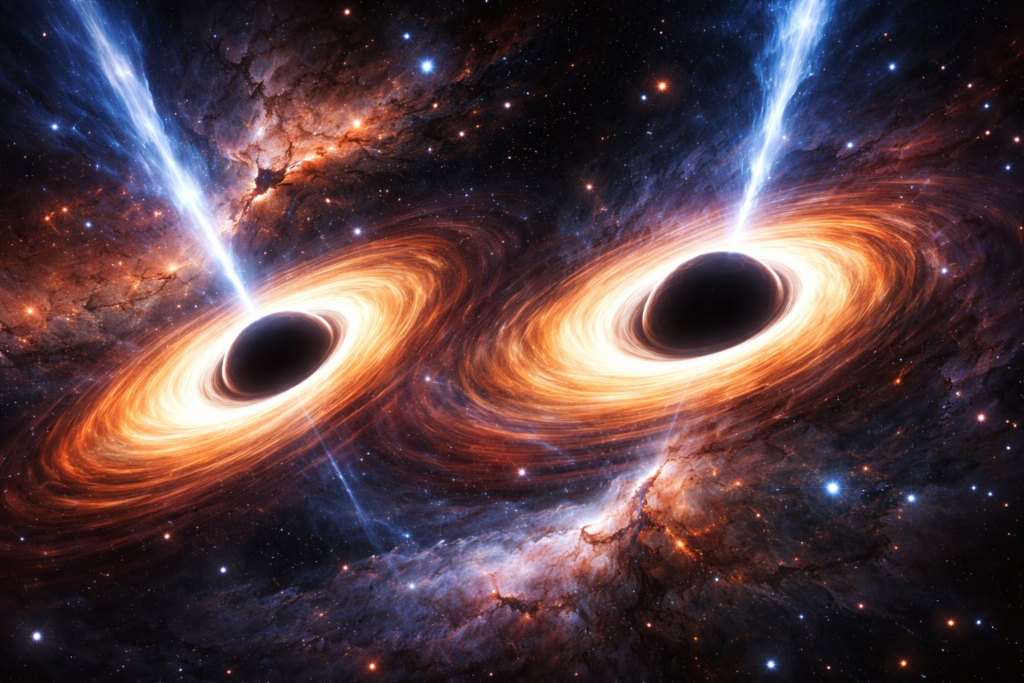
1. Stellar Black Holes: These are the most common, formed directly from the collapse of massive stars. Our Milky Way galaxy alone is estimated to contain anywhere between 10 million and 1 billion stellar black holes.
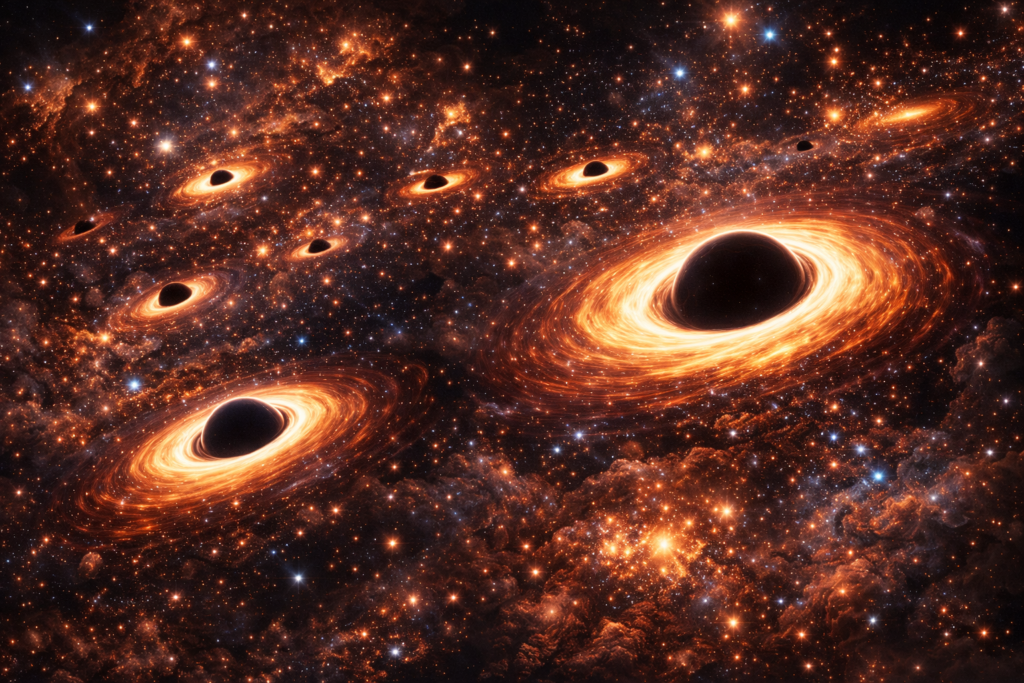
2. Primordial Black Holes: These are currently hypothetical and theoretical. They are thought to be as tiny as a single atom but possess the massive weight of a mountain.
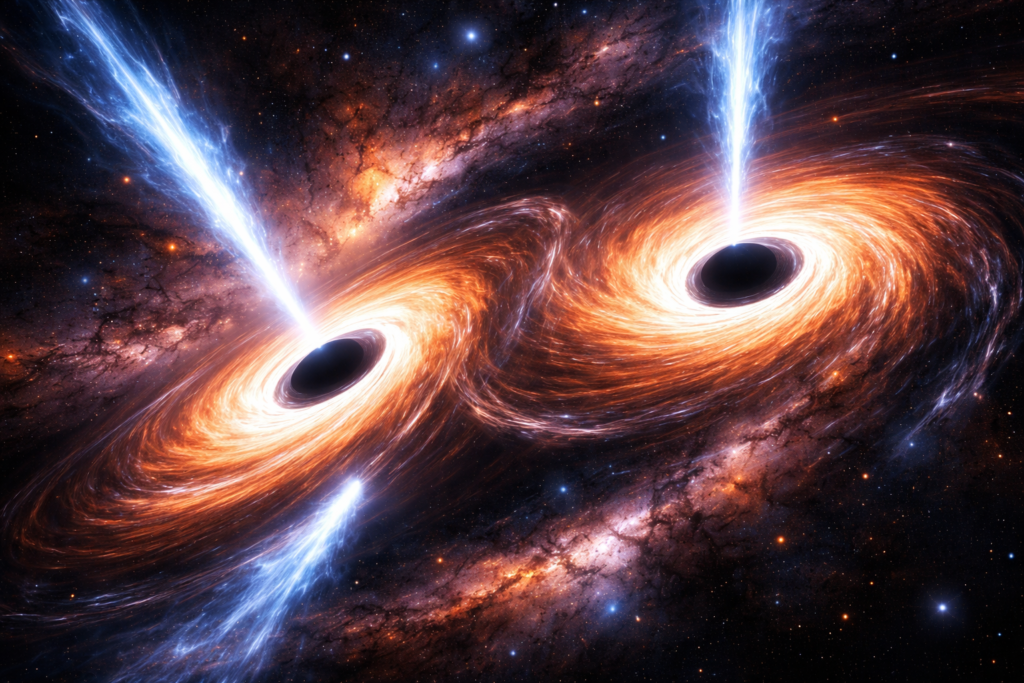
3. Supermassive Black Holes: These are enormous cosmic monsters whose mass exceeds that of a million Suns combined, yet they can fit into a spherical diameter roughly the size of our entire Solar System. It is believed that a supermassive black hole sits at the very center of every major galaxy. For instance, the one at the center of our Milky Way is named Sagittarius A*, and the fictional Gargantua from Interstellar was also a supermassive black hole.
4. Intermediate Black Holes: This is a theorized fourth category, sizing somewhere between stellar and supermassive black holes, though no definitive proof of their existence has been discovered yet.
The Visual Anatomy of a Black Hole Despite the imposing name, a black hole does not just look like a big black ball vacuuming up everything around it. Because of its immense gravitational pull, it attracts large amounts of gaseous matter and debris that orbit around it, much like planets successfully orbit the Sun. This violently spinning matter creates several fascinating visual phenomena:
• The Accretion Disk: As debris revolves around the black hole at incredibly high speeds, the particles rub together, compress, and heat up to over a million degrees Celsius, turning into a flowing, fluid-like fire. This glowing ring of matter is called the accretion disk, and it emits intense electromagnetic radiation, primarily in the form of X-rays. While Interstellar depicted this disk as orange-yellow to make it understandable to human eyes, the actual color would theoretically lean closer to blue, as real X-rays lay entirely outside the visible light spectrum.
• The Doppler Beaming Effect: If you look at an actual image of a black hole, you will notice that one side of the spinning disk is noticeably brighter than the other. This happens because the glowing particles spinning towards us appear much brighter, while the ones spinning away from us appear dimmer.
• Gravitational Optical Illusion: When viewed from the side, a black hole’s gravity literally bends the light coming from the back of the accretion disk. This forces the light to move over the black hole, making it look as though the glowing disk arches over the top and bottom simultaneously. If viewed from directly above, however, it would just look like a normal, flat, round disk.
• The Photonsphere: As you move closer toward the center, you encounter the last circle of light called the Photonsphere. Here, gravity is so strong that photons (the particles that make up light) are literally forced to travel in a continuous orbit around the black hole. Theoretically, if you stood perfectly alive in this region, the light would travel in such a perfect circle that you could see the back of your own head in front of you.
• The Event Horizon: This is the absolute boundary of no return. Beyond this specific point, the gravitational pull is so extreme that absolutely nothing, not even light itself, can escape, making everything past this point completely black from the outside.
• The Singularity: At the very center lies the Singularity. According to Einstein’s General Theory of Relativity, this is the core where the mesh of space-time is stretched and bent infinitely. Because of this infinite curvature, gravitational force becomes boundless, causing time itself to slow down infinitely.
What Happens If You Fall In? If you were to successfully cross the Event Horizon, theoretically, there is absolutely zero chance of you escaping. Interstellar creatively imagines a five-dimensional tesseract space inside, but that was purely speculative imagination designed with the help of a Nobel Prize-winning physicist to fill in the blanks of what science simply hasn’t discovered yet. Some fascinating theories suggest that since light is absorbed, it might reflect infinitely off multiple points inside the Event Horizon before ever hitting the Singularity, meaning you might actually be able to see things illuminated inside.
However, the harsh biological reality is that if a human fell into a black hole, the immense, unequal gravitational forces would completely disintegrate them into pieces within mere milliseconds.
On April 10, 2019, humanity captured the very first actual photograph of a black hole using the Event Horizon Telescope, proving their existence practically, roughly 100 years after they were first theorized.
Finally, there is absolutely no need to fear that black holes will eventually suck up all matter and end the entire universe. A supermassive black hole sits at the center of our galaxy, and stars and planetary bodies simply revolve around it in a stable orbit, just as planets revolve safely around the Sun. As long as we maintain a proper cosmic distance, we remain completely safe and secure from their terrifying power
Read More :
AI Is Running Colleges Now: How Agentic AI Is Perfectly Reshaping Higher Education in 2026
Sleep Hygiene : Why You’re Tired Even After 8 Hours Sleep and How to Fix It