

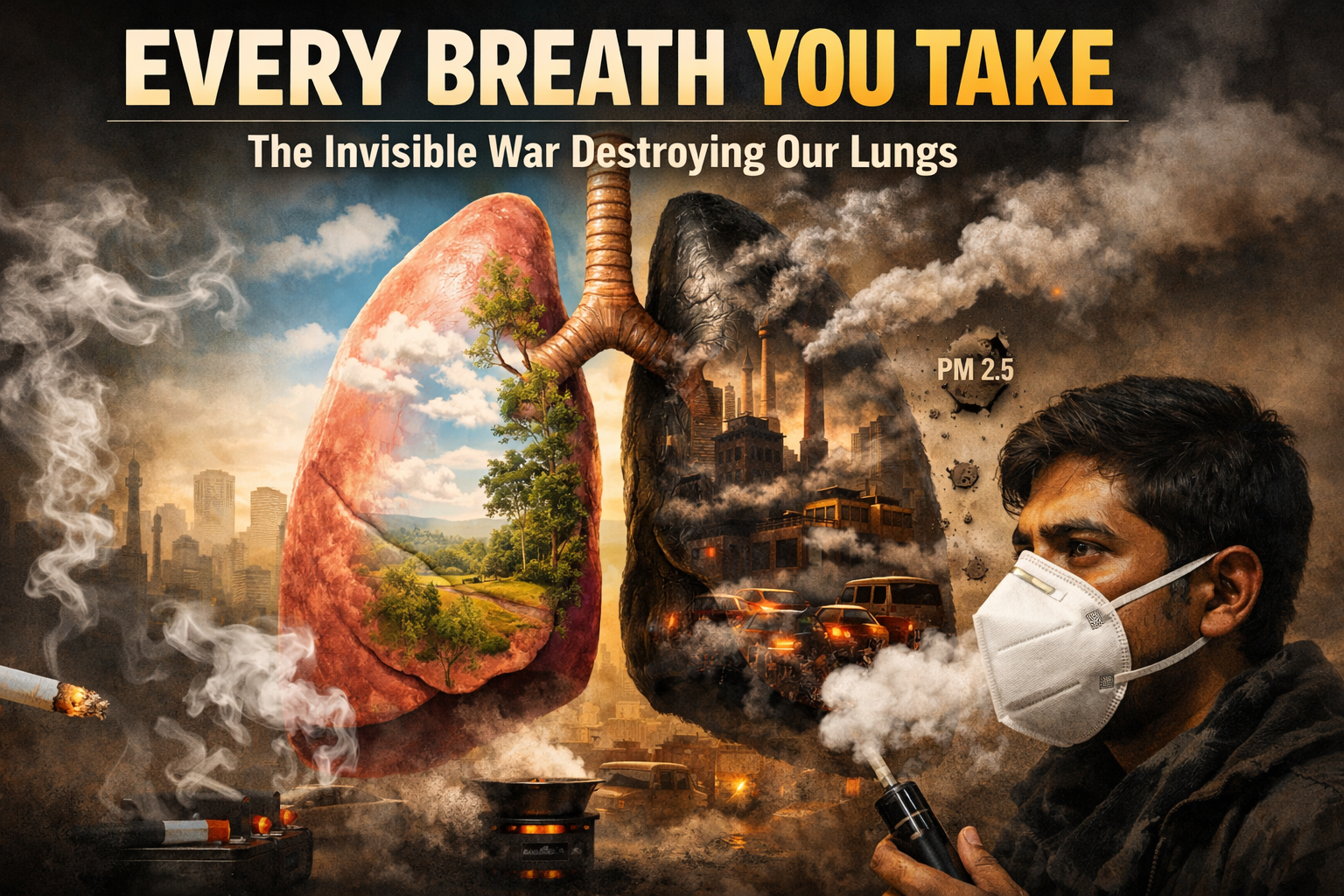
The critical respiratory crisis currently facing India due to escalating air pollution and lifestyle habits. Lung disease is poised to become the nation’s primary cause of death, even non-smokers are developing severe damage equivalent to heavy cigarette use. The systemic dangers of vaping, the often-overlooked risks of passive smoking, and the specific impact of indoor cooking fumes on rural families. Using N95 masks, evaluating air purifiers, and performing breathing exercises to bolster pulmonary resilience. Ultimately, Treat environmental toxicity as a national health emergency while urging individuals to adopt stricter personal health standards.
The next 20 years will see a drastic shift: lung diseases are on track to become the number one cause of death. While the COVID-19 pandemic suddenly shifted the world’s focus to respiratory health, our lungs were already under severe attack from aging, soaring pollution levels, and various infections.
The lungs are incredibly unique and vulnerable; unlike the brain, heart, or liver, which are safely tucked away inside the body and only receive blood, the lungs are the only internal organs directly exposed to the outside air. Today, the reality is terrifying. Just a few years ago, we could easily distinguish between the black, diseased lungs of a smoker and the healthy, pink lungs of a non-smoker. Today, the lungs of non-smokers have become just as black, dangerous, and prone to disease. In fact, an alarming 70% of new lung disease cases are occurring in people who have never smoked a day in their lives.
The Silent Epidemic of Air Pollution
Air pollution is no longer just an environmental issue or a matter of chemical metrics; it is a pure, existential health crisis. Every single day, air pollution kills more people worldwide than all wars, malaria, HIV, and AIDS combined, and it claims more lives annually than the entire COVID-19 pandemic did. In India alone, nearly 30 people die every single day simply because they are breathing. If you live in a highly polluted city like Delhi, your life expectancy is being cut short by roughly 5.3 to 5.5 years.
The pollution comes from two main sources: dust (from roads, construction, and fields) creating Particulate Matter (PM 10 and PM 2.5), and toxic gases (carbon monoxide, sulfur oxides, nitrogen oxides, ammonia, and ozone) from industrial smoke, vehicle exhaust, and the burning of fossil fuels and plastic waste. We take an average of 25,000 breaths every day, and with every breath, we are inhaling this toxic cocktail.
The damage is not limited to the lungs. From head to toe, no organ is spared:
- Brain Damage: Toxins enter the bloodstream through the lungs and travel to the brain, causing neuro-inflammation. This is linked to hyperactivity in children, a drop in IQ by up to 10 points in highly polluted areas, and an increased risk of strokes, paralysis, Alzheimer’s, dementia, and sleep disorders.
- Heart Disease: Pollution causes premature hypertension in children, and heart attacks and arrhythmias in adults.
- Metabolic Disorders: The toxins affect the pancreas, contributing to India’s rise as the diabetes capital of the world (where nearly 20% of the population is diabetic or pre-diabetic). Furthermore, toxins deposit in fat cells, disrupting metabolism and heavily contributing to the rising rates of childhood obesity.
- Pregnancy Risks: Pregnant women breathing polluted air pass cancer-causing agents through the placenta to the fetus. This leads to severe congenital defects, intrauterine growth retardation, premature deliveries, and even fetal death.
The Hidden Threat of Indoor Air Pollution
Pollution isn’t just an outdoor problem. Globally, indoor air pollution and cooking gases account for 7 million recorded deaths. In rural areas, 50-60% of households still use biomass fuels (wood, cow dung, coal) in poorly ventilated rooms. The black smoke emitted can contain PM 2.5 levels up to an astonishing 25,000 micrograms per cubic meter. Even in urban homes using piped gas or cylinders, invisible but harmful gases are released during cooking.
The Solution: Always install and use both a kitchen chimney and an exhaust fan. Turn them on before you ignite the stove, and leave them running for 10 minutes after you finish cooking to ensure the toxic gases are entirely flushed out.
Busting the Myths: Gadgets and “Lung Detox”
Air Purifiers: These are not a public solution to a mass problem. They only work in strictly confined spaces where all doors and windows are tightly closed. A cheap air purifier is often useless; a good one requires a highly sensitive, high-quality HEPA filter, an appropriate motor capacity for the room’s square footage, and a built-in meter to prove it is actively reducing particulate matter. Furthermore, in heavily polluted cities, filters choke and turn completely black within 3 to 4 months. If not replaced, the machine becomes a “dirty-fier” that blows carbon back into your room. While they are highly recommended for vulnerable populations (like the elderly, post-surgery patients, or those with asthma and COPD), they are not a viable, permanent solution for the general public.
Masks: Cloth masks and basic surgical masks offer zero protection against pollution; the gases and particulate matter simply slip through. Only N95 masks work because their microscopic pores block 95% of particulate matter. However, they only work if they form a completely airtight seal over your nose and mouth. Crucial Warning: Never exercise, run, or cycle while wearing an N95 mask. The resistance makes it hard to pull in the extra oxygen your body needs, which can lead to dangerously low oxygen levels and cause severe harm.
The Deadly Traps: Smoking, Passive Smoking, and Vaping
Smoking & Passive Smoking: Cigarettes, bidis, and cigars contain nicotine—a highly addictive chemical that instantly stimulates the brain. However, the real danger lies in the burning of tobacco, which releases over 70 WHO-certified cancer-causing chemicals that damage every organ in the body. There are three types of exposure:
- Primary: The smoker directly inhaling the smoke.
- Secondary (Passive): People in the same room inhaling the ambient smoke. This is often worse than primary smoking. The smoker inhales through a filter, but the smoke wafting off the burning end of the cigarette is completely unfiltered. Spouses and children in smoking households suffer heavily from chest diseases and have an equal risk of developing lung cancer.
- Tertiary: Smoke particles settle and absorb into carpets, curtains, and furniture. Toddlers crawling on these surfaces inhale these lingering toxins. If you are a non-smoker, you must strictly avoid enclosed smoking areas, such as bar rooms in clubs, which act like toxic furnaces. If a pregnant woman smokes, the toxins cross the blood-brain barrier and placenta, causing severe birth defects and miscarriages.
Vaping / E-Cigarettes: Vaping is falsely marketed as a “safe alternative” to smoking. Instead of burning tobacco, e-cigarettes use a battery to heat highly volatile ethers, polyethylene glycol, and glycerin into an aerosol. This is a completely unregulated industry. While the ingredients might be labeled “safe for human consumption” (meaning safe to eat), they are absolutely not safe for inhalation into the lungs. Vaping causes severe brain damage, heart damage, endocrine disruption, and even traumatic burn injuries from exploding batteries. It is a dangerous trap, especially for the youth.
The Changing Face of Lung Cancer
Traditionally, lung cancer was a disease of older men in their 50s and 60s who had smoked for 30 years. Today, the demographics have shifted tragically. Because 22 micrograms of PM 2.5 is equivalent to smoking one cigarette, a child born in a highly polluted city (AQI 300) is essentially smoking 15 cigarettes a day from birth.
By the time they reach their 20s or 30s, their tissues have endured decades of cancer-causing exposure. This is why we are seeing a massive spike in lung cancer among young people, women, and non-smokers.
Compounding the tragedy is the issue of misdiagnosis. The two primary early symptoms of lung cancer—a persistent cough and coughing up blood—are identical to the symptoms of Tuberculosis (TB). Because TB is so common, young patients are often mistakenly treated for TB for 3 to 6 months. By the time the error is realized, the highly curable early-stage lung cancer has progressed to an incurable Stage 4.
Actionable Steps to Protect and Strengthen Your Lungs
We cannot change the air overnight, but we can take immediate steps to fortify our bodies and environment:
1. Test Your Lung Health: Take a deep breath and hold it. If you can hold your breath for more than 45 seconds, your lungs are generally in a healthy state.
2. Practice Lung-Strengthening Exercises:
- Posture Correction: Stop slouching. Sit with your spine straight and shoulders pulled back. This gives your lungs their natural, maximum space to expand.
- Breath Holding: Practice taking deep breaths, holding them, and slowly releasing. This stretches the lung tissue, removing stiffness and increasing their elasticity.
- Cardio Workouts: Engage in 30 to 40 minutes of cardio (like static cycling with resistance, or skipping) 5 to 6 days a week. The goal is to warm up, reach a pace where you are slightly out of breath, sustain that for 20-25 minutes, and cool down.
3. Make Lifestyle and Policy Shifts:
- Quit Smoking and Vaping immediately. Utilize nicotine replacement therapies and psychological counseling. Family support is the most powerful tool for quitting.
- Stop using single-use plastic. Use cloth bags. Millions of tons of plastic end up in massive dumping grounds. When these mountains of trash catch fire, they release the most toxic smoke imaginable.
- Segregate your waste at home (dry vs. wet) to reduce the sheer volume of garbage that ends up being burned.
- Demand civic action. Write to local municipalities to fix broken, unpaved roads which are massive contributors to dust pollution.
Air pollution and lung degradation are no longer distant threats; they are a health emergency happening inside our bodies right now. We must treat this with the exact same urgency and determination that we applied to the COVID-19 pandemic. By combining personal health routines, abandoning toxic habits like vaping and smoking, and demanding cleaner environmental practices, we can fight back against the invisible poison in our air.
Read More:
Mobile Phone Addiction Is Destroying Gen Z! What Parents Can Do (Practical Solutions in 2026)