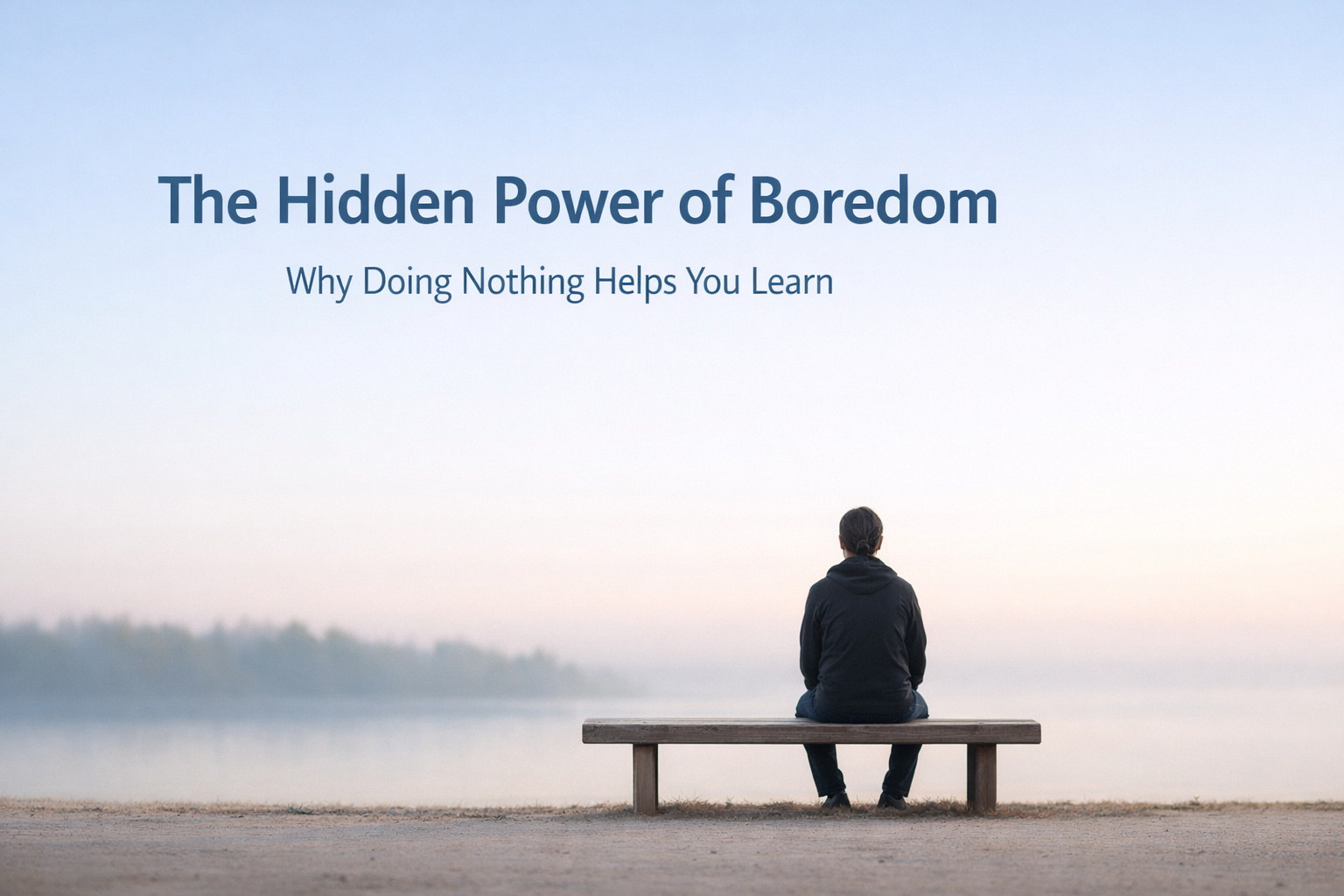
What is “Hidden Power of Boredom“.Have you ever think about it?
Be honest. When was the last time you were truly bored?
Not “waiting in line while scrolling Instagram” bored. Not “listening to a podcast while washing dishes” bored.
I mean actually bored. Staring at a wall. Sitting on a bench. Letting your mind wander without input.
If you’re like most people, you can’t remember.
We live in an age of constant stimulation. Every gap in our day gets filled. Elevator ride? Check emails. Walking to the car? Listen to a audiobook. Waiting for coffee? Scroll social media.
We treat boredom like a disease. Something to be cured. Something to be avoided at all costs.
But here’s the twist: Boredom isn’t the enemy of productivity. It’s the secret ingredient.
Science shows that doing nothing is actually when your brain does some of its best work. It’s when memories stick. It’s when ideas connect. It’s when learning actually happens.
If you want to learn faster, think clearer, and feel calmer, you might need to do less—not more.
Why boredom is good for your brain (Hidden Power of Boredom)
Let’s clear something up. Boredom doesn’t mean laziness. It doesn’t mean giving up.
Boredom is a state of low external stimulation. It’s when your brain isn’t focused on a specific task.
For years, scientists thought this was wasted time. They thought the brain was “idling” like a car engine at a stoplight.
They were wrong.
When you stop focusing on the outside world, your brain switches to a different mode. Researchers call it the Default Mode Network (DMN).
What Is the Default Mode Network?
Think of your brain like a house.
- Task Mode: When you’re studying, working, or reading, the lights are on in the “work rooms.”
- Default Mode: When you zone out, daydream, or sit quietly, the lights switch to the “connection rooms.”
In this mode, your brain isn’t sleeping. It’s busy.
It’s:
- Connecting new information to old memories
- Processing emotions
- Planning for the future
- Generating creative ideas
A study published in Neuron found that activity in the Default Mode Network is crucial for memory consolidation and self-reflection. Without downtime, these processes get interrupted.
So when you feel “zoned out,” you’re actually zoning in to your inner world.
How doing nothing improves memory and focus (Hidden Power of Boredom)
You’ve probably experienced this: You study for hours. You highlight everything. You re-read your notes. But during the test, you blank out.
Why? Because you never gave your brain time to save the file.
Learning happens in two stages:
- Encoding: Taking in new information (studying, listening, practicing).
- Consolidation: Stabilizing that information into long-term memory (resting, sleeping, doing nothing).
Most people focus only on stage one. They cram. They hustle. They push through fatigue.
But consolidation requires silence.
The Science of Rest Breaks
Research from the University of Texas shows that taking short, non-stimulating breaks during learning improves memory recall by up to 40%.
Notice the key word: Non-stimulating.
Checking your phone isn’t a rest break. It’s new input. It’s more encoding.
True rest means:
- Closing your eyes
- Staring out a window
- Walking without music
- Sitting quietly with your thoughts
When you do this, your brain replays the neural patterns you just learned. It strengthens the connections. It moves info from short-term to long-term storage.
If you skip this step, you’re like someone trying to fill a bucket with a hole in the bottom. No matter how much you pour in, it leaks out.
The link between boredom and creativity
Have you ever had a great idea in the shower? Or while driving? Or while walking the dog?
Rarely do breakthroughs happen when you’re staring at a spreadsheet.
Creativity is about making connections between unrelated ideas. And those connections happen in the quiet spaces.
When your brain is bored, it starts to wander. It searches for something interesting. It digs through old memories. It combines concepts in new ways.
Albert Einstein famously said, “Creativity is the residue of time wasted.”
He wasn’t joking. Some of his best insights came while playing the violin or sailing—activities that required little mental effort.
Why Constant Input Kills Ideas
When you consume content all day (videos, articles, posts), your brain is in “receive mode.”
To create, you need to be in “generate mode.”
You can’t generate if you’re constantly receiving. It’s like trying to talk while someone else is shouting at you.
Boredom creates the silence needed for your own voice to emerge.
Practical ways to embrace boredom daily (Hidden Power of Boredom)
You don’t need to meditate for an hour or go on a silent retreat. You just need to create small pockets of nothingness.
Here’s how to build boredom into your busy life:
1. The 5-Minute Pause
After a learning session (reading, meeting, class), stop for 5 minutes.
- Close your laptop.
- Put your phone away.
- Sit quietly.
- Let your mind wander.
Don’t try to think about anything specific. Just let it be.
2. Walk Without Audio
Next time you go for a walk, leave the headphones at home.
- No podcasts.
- No music.
- No calls.
Just walk. Notice your surroundings. Let your thoughts drift. This is where problem-solving happens.
3. Create “No-Phone Zones”
Pick one space or time where phones aren’t allowed.
- The dinner table.
- The bedroom.
- The first 30 minutes after waking up.
This forces your brain to find its own entertainment instead of scrolling.
4. Embrace Waiting
Standing in line? Waiting for a friend? Stuck in traffic?
- Resist the urge to pull out your phone.
- Just wait.
- Observe. Breathe. Think.
Turn dead time into brain time.
5. Schedule “Do Nothing” Time
It sounds counterintuitive, but put it on your calendar.
- 15 minutes of unstructured time.
- No goals. No tasks. No output.
Treat it like a meeting with yourself.
Common mistakes people make with rest (Hidden Power of Boredom)
Not all downtime is created equal. Here’s what doesn’t count as productive boredom:
❌ Scrolling Social Media
This is high stimulation. Your brain is processing images, text, and emotions. It’s not rest.
❌ Binge-Watching Shows
Passive consumption still requires attention. It doesn’t activate the Default Mode Network the same way.
❌ Worrying While Sitting Still
If you’re sitting quietly but stressing about your to-do list, that’s anxiety—not boredom. Try to let go of outcomes during this time.
❌ Expecting Immediate Results
Boredom isn’t a magic pill. You won’t have an epiphany in 30 seconds. It’s a long-term investment in brain health.
✅ The Goal: Low stimulation + No specific task = True mental rest.
Signs you need more boredom in your life
How do you know if you’re over-stimulated? Watch for these signals:
- Brain Fog: You read a paragraph but don’t remember what it said.
- Irritability: Small annoyances bother you more than usual.
- Creative Block: You feel stuck on problems that should be solvable.
- Phone Anxiety: You feel uneasy when you can’t check your device.
- Poor Recall: You struggle to remember things you learned recently.
If these sound familiar, your brain is screaming for a break.
Listen to it.
Conclusion: Stop Filling Every Gap
We’ve been taught that every second must be productive. That idle time is wasted time.
But your brain doesn’t work like a machine. It works like a garden.
You can’t pull on the seedlings to make them grow faster. You have to water them, give them sun, and then… wait.
Boredom is the waiting. It’s the space where growth happens.
So today, try something radical.
- Sit quietly for 5 minutes.
- Leave your phone in the other room.
- Let yourself be bored.
It might feel uncomfortable at first. That’s okay. Push through the urge to distract yourself.
On the other side of that boredom is clarity. Creativity. And better learning.
Do less. Learn more.
Also Read:
Slow Metabolism? 7 Science-Backed Ways to Boost It Naturally
Frequently Asked Questions (FAQs)
Q: Is boredom the same as depression?
A: No. Boredom is a temporary state of low stimulation. Depression is a persistent mental health condition. If you feel hopeless or empty consistently, please speak to a professional.
Q: How long should I be bored to see benefits?
A: Even 5–10 minutes of non-stimulating rest can help. Aim for a few short breaks throughout your day.
Q: Can I listen to instrumental music during boredom?
A: Ideally, silence is best for activating the Default Mode Network. But calm, lyric-free music is better than podcasts or videos.
Q: Will this make me less productive?
A: It may feel that way initially. But long-term, it improves focus and memory, making your work time more efficient.
Q: What if my mind races when I stop?
A: That’s normal. Your brain is used to noise. Gently bring your attention back to your breath or surroundings without judging yourself.