
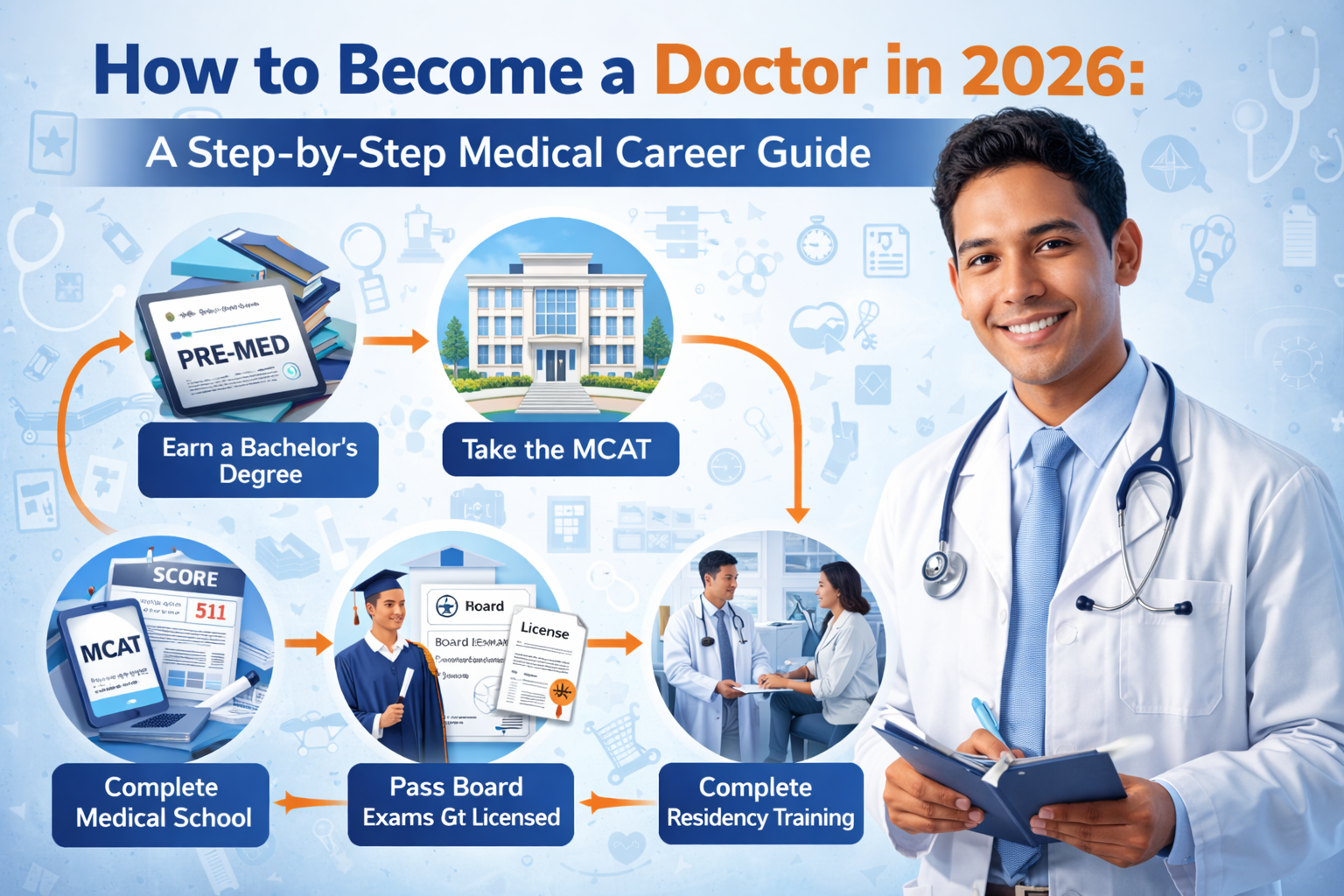
The medical profession remains one of the most respected and rewarding careers globally. However, the path to wearing the white coat is long, demanding, and requires a strategic roadmap. Whether you are a high school student or an aspiring medical professional, this 2026 guide to becoming a doctor breaks down the journey from entrance exams to your first day of residency.
Why Pursue a Medical Career in 2026?
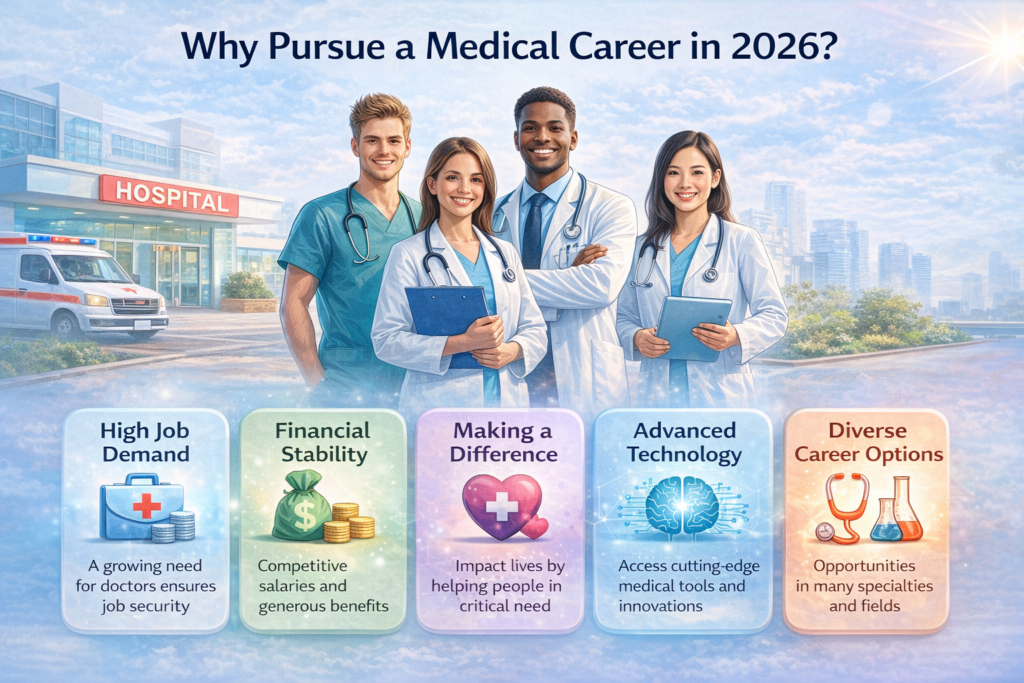
In 2026, the healthcare landscape is evolving rapidly with the integration of AI-assisted diagnostics and personalized medicine. Despite these tech advancements, the need for skilled physicians is at an all-time high. Choosing a medical career path offers job security, financial stability, and the unparalleled opportunity to save lives.
Phase 1: High School Preparation (The Foundation)
Your journey begins long before you enter a hospital. To be eligible for medical school, you must focus on the right academic foundation.
- Core Subjects: Focus on Physics, Chemistry, and Biology (PCB). High proficiency in these subjects is mandatory for almost all global medical boards.
- Academic Excellence: Most top-tier medical colleges require a minimum of 50–60% in your board exams, though competitive scores are usually much higher.
- Volunteer Work: In 2026, medical boards are looking for “holistic” candidates. Gaining experience through hospital volunteering or Red Cross programs can significantly boost your application.
Phase 2: Cracking the Medical Entrance Exams
The biggest hurdle for any aspiring doctor is the entrance examination. Depending on where you want to practice, the requirements differ:
1. NEET (India)
For students in India, the National Eligibility cum Entrance Test (NEET) is the single gateway to all MBBS and BDS seats.
- Pro-Tip: Focus on NCERT textbooks; 90% of the Biology section is historically derived from them.
2. MCAT (USA/Canada)
If you are aiming for North America, the Medical College Admission Test (MCAT) is essential. It tests your problem-solving, critical thinking, and knowledge of natural, behavioral, and social sciences.
3. USMLE (International License)
For those looking to practice in the United States, starting your USMLE Step 1 preparation early in your medical school years is vital for securing a residency.
Phase 3: The MBBS or MD Journey
Once you clear your entrance exams, you enter medical school. This is usually a 5-to-6-year commitment.
- Pre-Clinical (Years 1-2): You will study the “basics”—Anatomy, Physiology, and Biochemistry. This is where you learn how a healthy body functions.
- Para-Clinical (Years 3-4): You move into Pathology, Microbiology, and Pharmacology—learning about diseases and the drugs used to treat them.
- Clinical Rotations (Final Years): This is the most exciting phase. You will rotate through different hospital departments like Surgery, Pediatrics, and Internal Medicine, interacting with real patients under supervision.
Phase 4: The Mandatory Internship
After passing your final university exams, you aren’t a practicing doctor yet. You must complete a one-year mandatory medical internship.
During this year, you are a “Junior Resident” or “Intern.” You work across various departments, gaining hands-on experience in emergency care, elective surgeries, and outpatient departments. This is the stage where you apply your theoretical knowledge to real-world medical crises.
Phase 5: Choosing a Specialization (MD vs. MS)
In the modern medical world, being a “General Physician” is often just the beginning. Most doctors choose to specialize to increase their expertise and earning potential.
- MD (Doctor of Medicine): A non-surgical specialty such as Cardiology, Neurology, or Pediatrics.
- MS (Master of Surgery): A surgical specialty such as Orthopedics, ENT, or General Surgery.
Phase 6: Licensing and Registration
The final step in how to become a doctor is getting your license.
- In India, you must register with the National Medical Commission (NMC) or your State Medical Council.
- Without this registration, you cannot legally practice medicine or prescribe medication.
The Cost of Becoming a Doctor in 2026
It is important to be realistic about the financial investment.
- Government Colleges: These are highly affordable but require top-tier entrance scores.
- Private Institutions: Costs can range significantly, sometimes reaching upwards of ₹60 Lakhs to ₹1 Crore in India, or $300,000+ in the US.
- ROI: While the initial cost is high, the doctor salary in 2026 remains one of the highest across all professional sectors, especially for specialists like Neurosurgeons or Cardiologists.
Summary Checklist for 2026 Aspirants
- Complete High School with Physics, Chemistry, and Biology.
- Clear the relevant Entrance Exam (NEET/MCAT).
- Complete 4.5 to 5 years of MBBS/MD.
- Finish a 1-year compulsory internship.
- Register with the National Medical Board.
- (Optional) Pursue Post-Graduation for specialization.
Becoming a doctor is a marathon, not a sprint. It requires patience, empathy, and a lifelong commitment to learning. If you are ready for the challenge, the year 2026 is an incredible time to start your journey.
Also Read:






One comment on “How to Become a Doctor in 2026: A Step-by-Step Medical Career Guide”