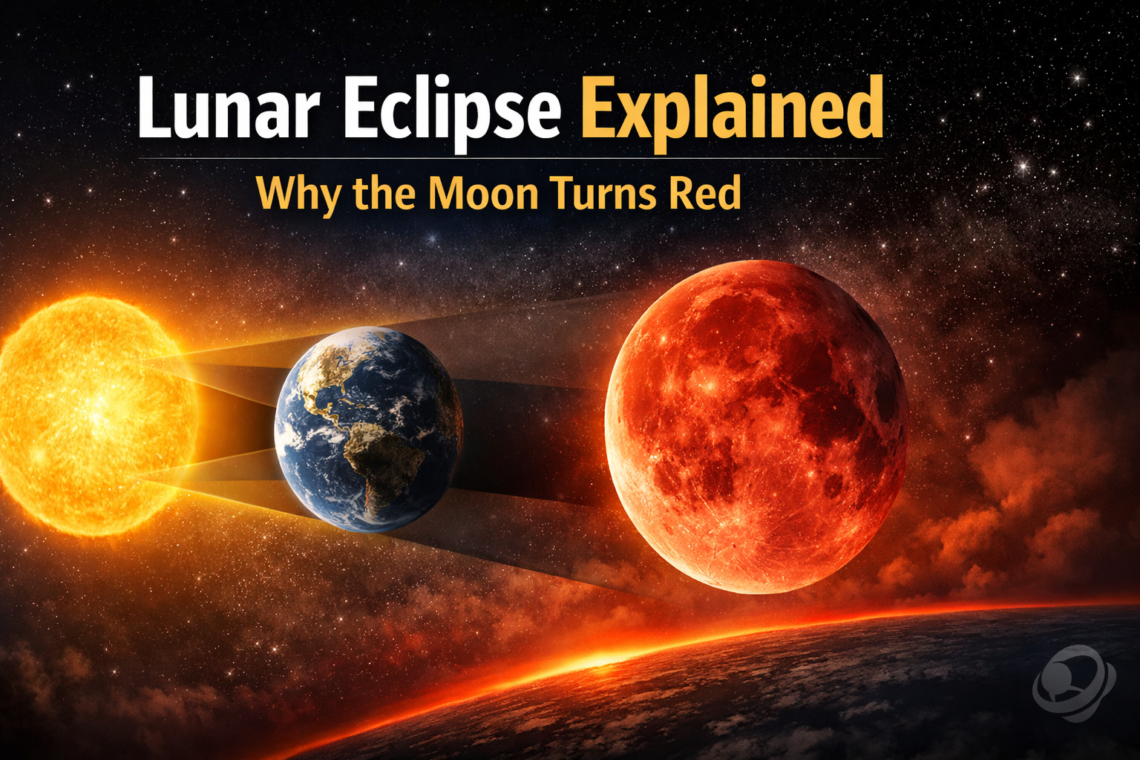
What Is a Lunar Eclipse?
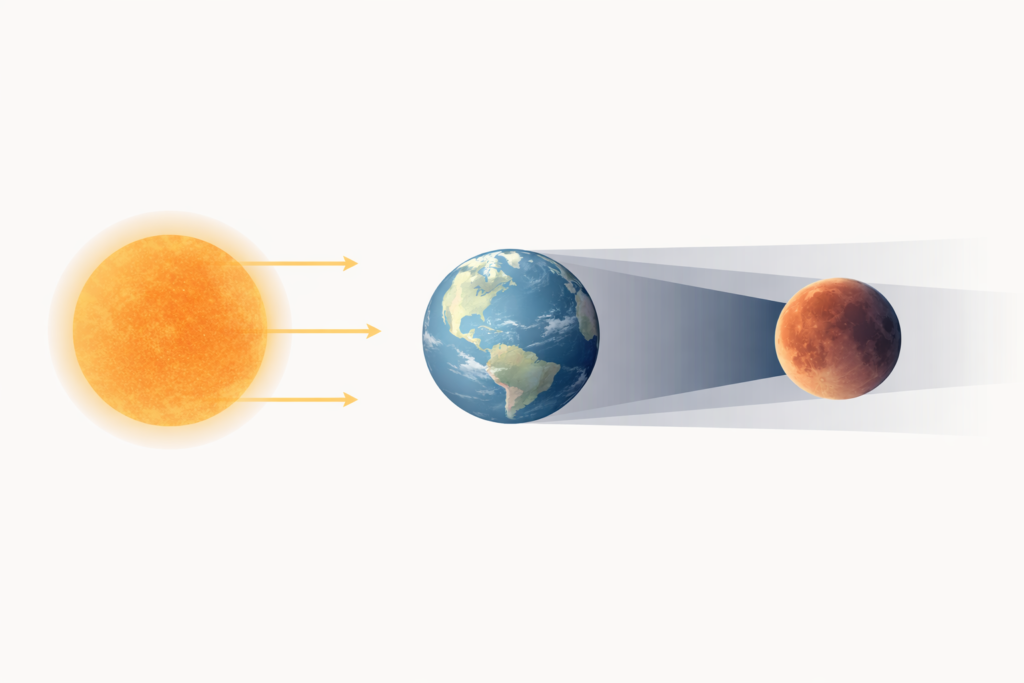
A lunar eclipse occurs when Earth passes directly between the Sun and the Moon, casting Earth’s shadow on the Moon. This celestial event can only happen during a full moon when the Sun, Earth, and Moon align perfectly (or nearly perfectly) in space.
Unlike solar eclipses, lunar eclipses are:
- Safe to view with naked eyes (no special equipment needed)
- Visible from anywhere on Earth’s night side
- Longer lasting (can last several hours)
- More frequent to observe from any given location
How Does a Lunar Eclipse Occur?
The Science Behind the Shadow
For a lunar eclipse to happen, three celestial bodies must align in this order:
Sun → Earth → Moon
Here’s the step-by-step process:
- Full Moon Phase: The Moon is on the opposite side of Earth from the Sun
- Orbital Alignment: The Moon’s orbit crosses Earth’s orbital plane (the ecliptic)
- Shadow Cast: Earth blocks sunlight from reaching the Moon
- Shadow Types: Earth casts two distinct shadows:
- Umbra: The dark, central shadow (total eclipse)
- Penumbra: The lighter, outer shadow (partial dimming)
Why Doesn’t It Happen Every Month?
The Moon’s orbit is tilted 5 degrees relative to Earth’s orbit around the Sun. Most months, the full Moon passes above or below Earth’s shadow.
Lunar eclipses only occur during eclipse seasons (about every 6 months) when the Moon’s orbit crosses Earth’s orbital plane at the same time as full moon.
Types of Lunar Eclipses
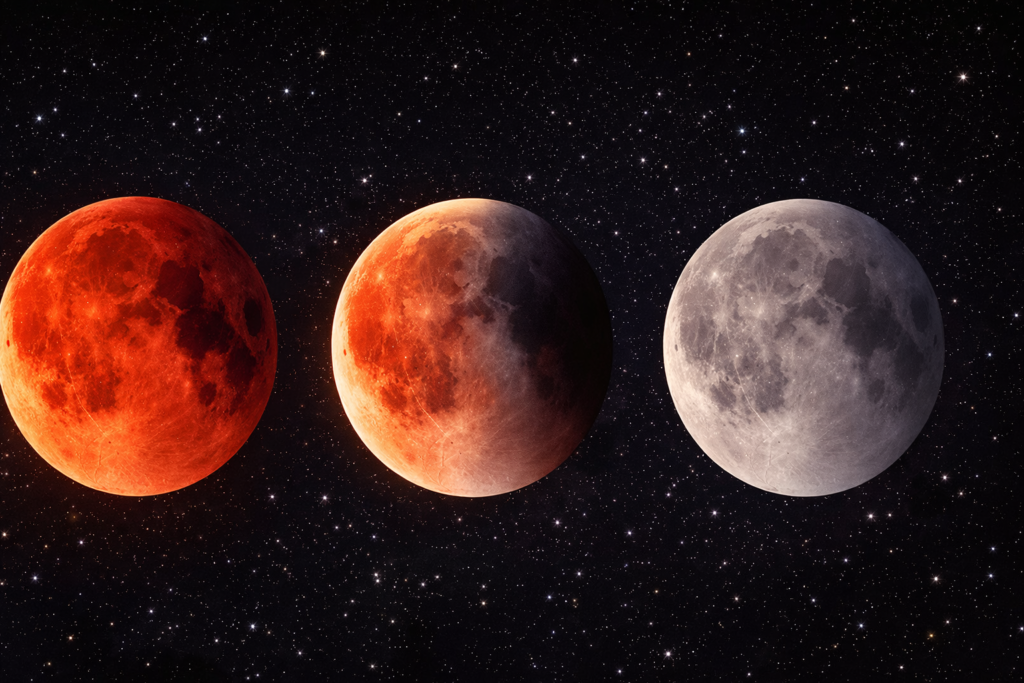
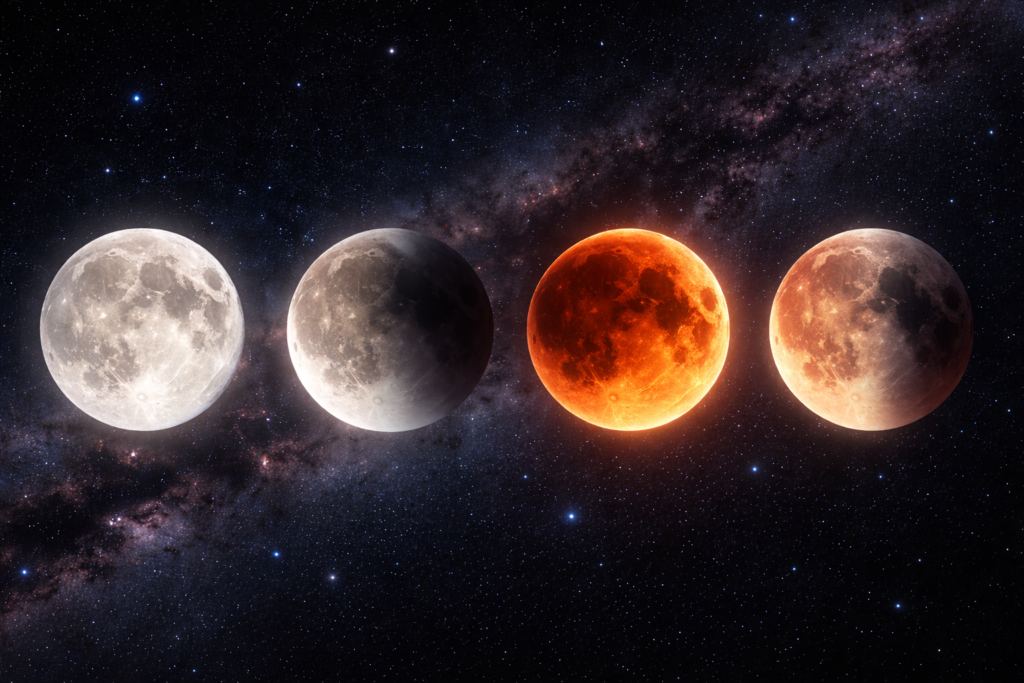
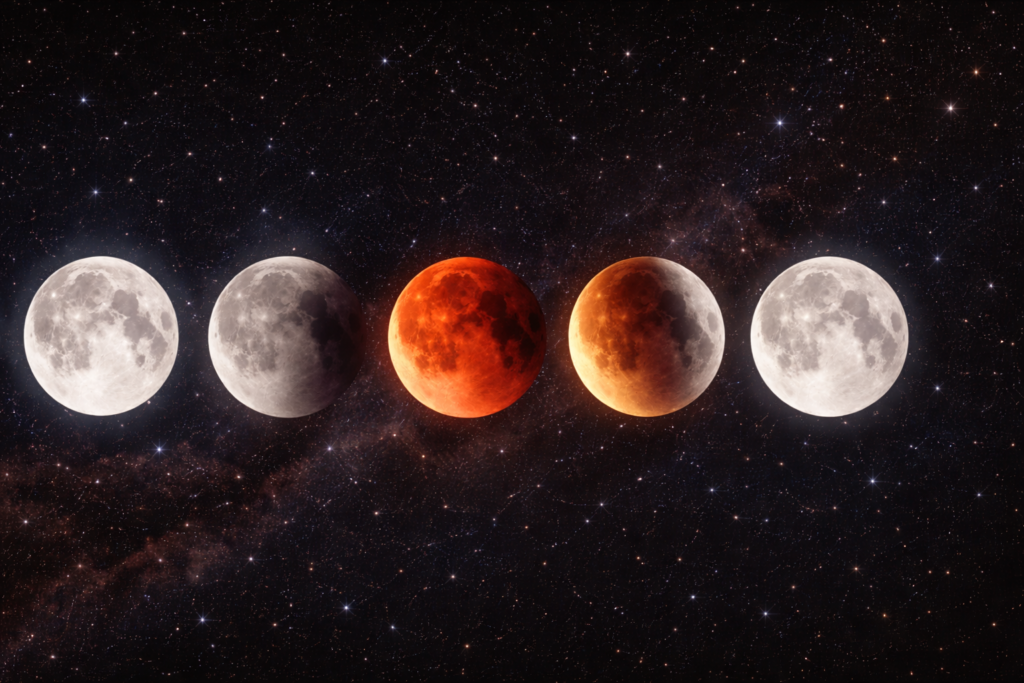
1. Total Lunar Eclipse 🌕 → 🌑 → 🌕
- The entire Moon passes through Earth’s umbra
- Moon turns reddish-orange (Blood Moon)
- Can last 1-2 hours
- Most dramatic type
2. Partial Lunar Eclipse 🌕 → 🌗 → 🌕
- Only part of Moon enters Earth’s umbra
- Looks like a “bite” taken out of the Moon
- Less common than total eclipses
3. Penumbral Lunar Eclipse 🌕 → 🌘 → 🌕
- Moon passes through Earth’s penumbra only
- Subtle dimming (hard to notice)
- Most common but least spectacular
Why Does the Moon Turn Red? (The Blood Moon)
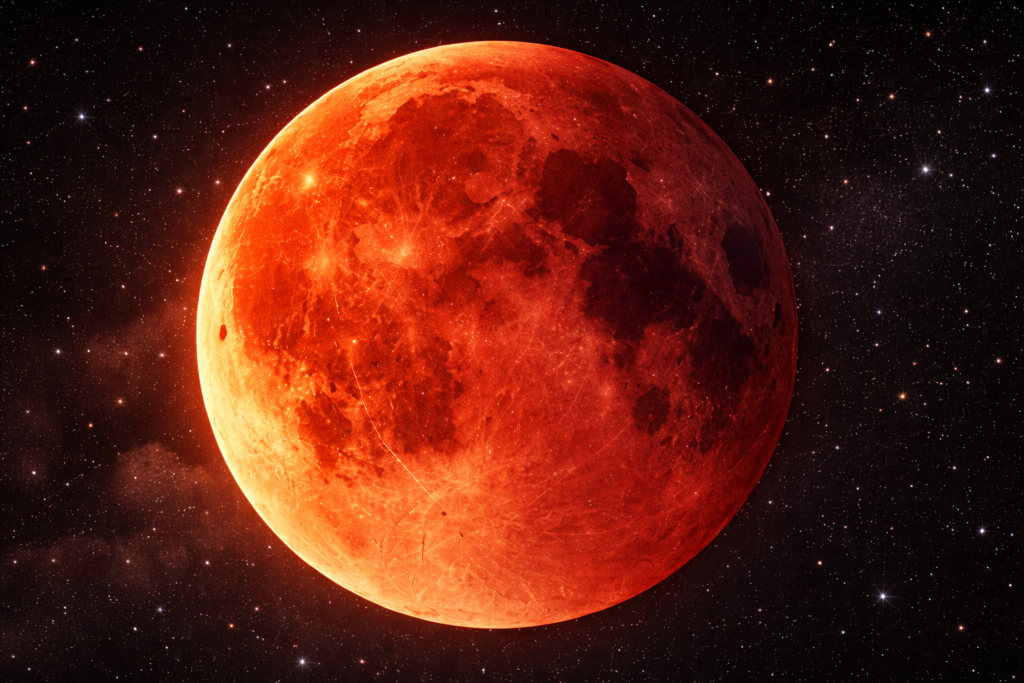
During a total lunar eclipse, the Moon doesn’t disappear completely. Instead, it glows red, orange, or copper. Here’s why:
Rayleigh Scattering
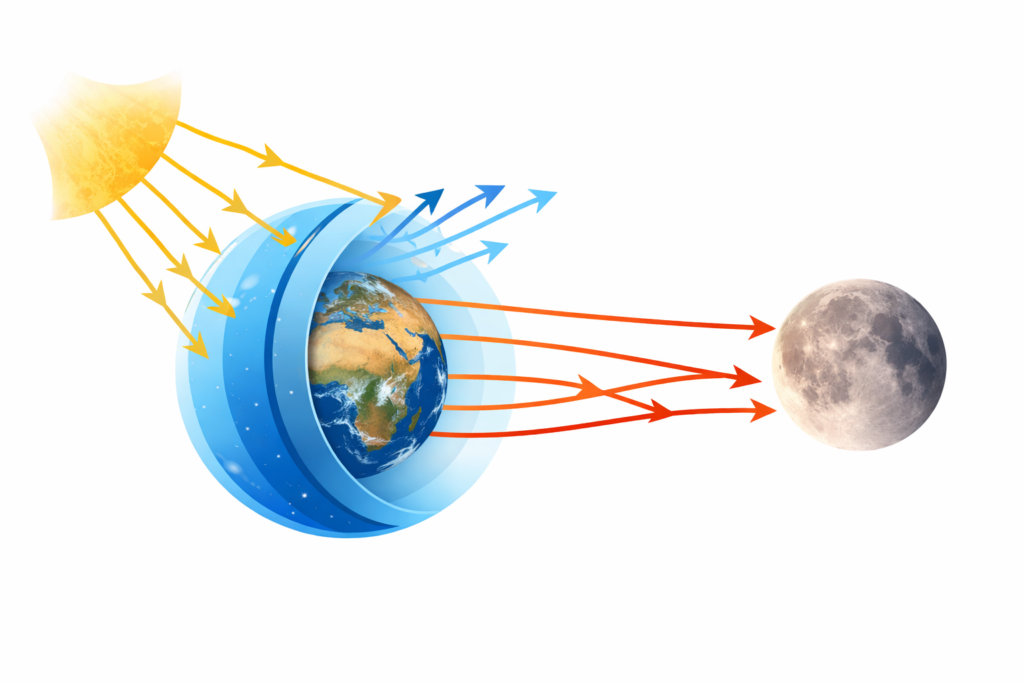
- Earth’s atmosphere bends (refracts) sunlight around the planet
- Blue light scatters away (same reason sky is blue)
- Red light passes through and reaches the Moon
- The Moon reflects this red light back to Earth
Fun fact: If you were standing on the Moon during a total lunar eclipse, you’d see Earth surrounded by a ring of red light—all the sunrises and sunsets on Earth happening at once!
The exact color depends on:
- Atmospheric conditions (dust, clouds, pollution)
- Volcanic activity (can make it darker/redder)
- Amount of particles in Earth’s atmosphere
Historical Significance
Ancient Observations
Babylonians (2000+ years ago)
- First to predict lunar eclipses using the Saros cycle (18 years, 11 days, 8 hours)
- Recorded eclipses on clay tablets
- Used them for calendar systems
Ancient Chinese
- Believed a celestial dragon devoured the Moon
- Made loud noises (drums, pots) to scare it away
- Recorded eclipse observations dating back to 1046 BCE
Greek Astronomers
- Aristotle (384-322 BCE) used lunar eclipses to prove Earth is round
- Noticed Earth’s shadow on Moon is always curved
- Calculated relative sizes of Earth and Moon
Christopher Columbus (1504)
- Used knowledge of a predicted lunar eclipse to intimidate Jamaican natives
- Told them his god would darken the Moon
- When eclipse happened, they provided him supplies
Also Read:
The Posture-Productivity Link: How Sitting Wrong Kills Your Focus (And 3 Fixes That Work)
Lunar Eclipses in Mythology & Culture
🌏 Hindu Mythology (India)
- Rahu and Ketu: Demon heads who chase Sun and Moon
- During eclipse, Rahu “swallows” the Moon
- People take ritual baths, chant mantras, avoid eating
- Considered inauspicious for new ventures
- Temples close during eclipse
🐉 Chinese Mythology
- Celestial Dragon eats the Moon
- People beat drums and make noise to frighten it away
- Word for eclipse in Chinese: 月食 (yuèshí) = “Moon eat”
🦎 Inca Civilization (South America)
- Believed a jaguar attacked the Moon
- Feared the jaguar would come to Earth next
- Made noise, waved spears at the Moon to scare the jaguar away
🐸 Vietnamese Folklore
- Giant frog eats the Moon
- Children clap and make noise to save it
🌙 Mesopotamian Beliefs
- Eclipses were omens against the king
- Temporary substitute king installed during eclipse
- Real king hidden for protection
⚡ Norse Mythology
- Wolves Sköll and Hati chase Sun and Moon
- Eclipse meant they were catching their prey
- Ragnarök (end of world) would come when they succeed
🦅 Native American Tribes
- Pomo (California): Bear cub fights with Moon
- Hupa (California): Moon’s wives failed to feed him properly
- Luiseno: Moon sick or dying
- Many tribes saw it as time for reflection and renewal
Modern Cultural Significance
📸 Photography & Tourism
- Eclipse chasing is a growing hobby
- Special tours organized for total lunar eclipses
- Photographers capture “Blood Moon” sequences
🔬 Scientific Research
- Study Earth’s atmosphere through eclipse colors
- Monitor volcanic ash and pollution levels
- Test instruments for space missions
🌍 Public Engagement
- Mass viewing events
- Educational opportunities for schools
- Social media phenomenon (#BloodMoon trends)
🎨 Art & Literature
- Inspiration for paintings, poems, songs
- Symbol of transformation, mystery, change
- Featured in movies and fantasy literature
When Do Lunar Eclipses Occur?
Frequency
- 2-5 lunar eclipses per year
- Total lunar eclipses: About once every 2.5 years (for any given location)
- Can occur in eclipse seasons (twice yearly, ~6 months apart)
Upcoming Notable Eclipses
- March 14, 2025: Total lunar eclipse (visible from Americas)
- September 7, 2025: Total lunar eclipse (visible from Europe, Asia, Africa)
- March 3, 2026: Total lunar eclipse
How to Watch
✅ No special equipment needed
✅ Safe for naked eye viewing
✅ Binoculars enhance the experience
✅ Best viewed from dark sky locations
✅ Check local times for your region
Lunar vs. Solar Eclipses: Key Differences
| Feature | Lunar Eclipse | Solar Eclipse |
|---|---|---|
| Alignment | Sun-Earth-Moon | Sun-Moon-Earth |
| Moon Phase | Full Moon | New Moon |
| Visibility | Entire night side of Earth | Narrow path on Earth |
| Duration | Hours | Minutes |
| Safety | Safe to view directly | Requires eye protection |
| Frequency | 2-5 per year | 2-5 per year |
| Color | Red/orange (total) | Black disk with corona |
Fun Facts About Lunar Eclipses
🌕 Longest total lunar eclipse in 21st century: July 27, 2018 (1 hour 43 minutes)
🌕 You can have 3 total lunar eclipses in one year, but it’s rare
🌕 Ancient Greeks used lunar eclipses to calculate Earth’s circumference
🌕 During a total lunar eclipse, the Moon is still visible because of Earth’s atmosphere
🌕 Selenelion: Rare event when Sun and eclipsed Moon are both visible (requires special atmospheric conditions)
🌕 Lunar eclipses have been photographed from space by astronauts on the ISS
🌕 The Danjon Scale rates the darkness of total lunar eclipses (L=0 to L=4)
Conclusion
Lunar eclipses are one of nature’s most accessible and awe-inspiring spectacles. What ancient civilizations feared as omens or dragon attacks, we now understand as a beautiful dance of celestial mechanics.
Yet, even with scientific understanding, watching the Moon transform from bright silver to deep red remains a powerful experience—a reminder of our place in the cosmos and the predictable yet magical rhythms of our solar system.
Next time there’s a lunar eclipse, step outside. Look up. And remember: you’re watching the same phenomenon that amazed our ancestors thousands of years ago.
Also Read:
- What is Lunar Eclipse? Types, Causes, History, Significance, Mythology, and Facts
- The Posture-Productivity Link: How Sitting Wrong Kills Your Focus (And 3 Fixes That Work)
- The Dark Truth Behind Your Favorite Cold Drinks: What Are You Really Consuming?
- Beyond the Event Horizon: The Fascinating Reality of Black Holes
- How to Break Down Big Goals Into Small, Doable Steps in 2026