An Invisible Pollutant Inside Us
Plastic pollution was once thought of as an external environmental problem—something floating in oceans, clogging landfills, or harming wildlife. But recent scientific discoveries have revealed a far more unsettling truth: plastic pollution has entered the human body.
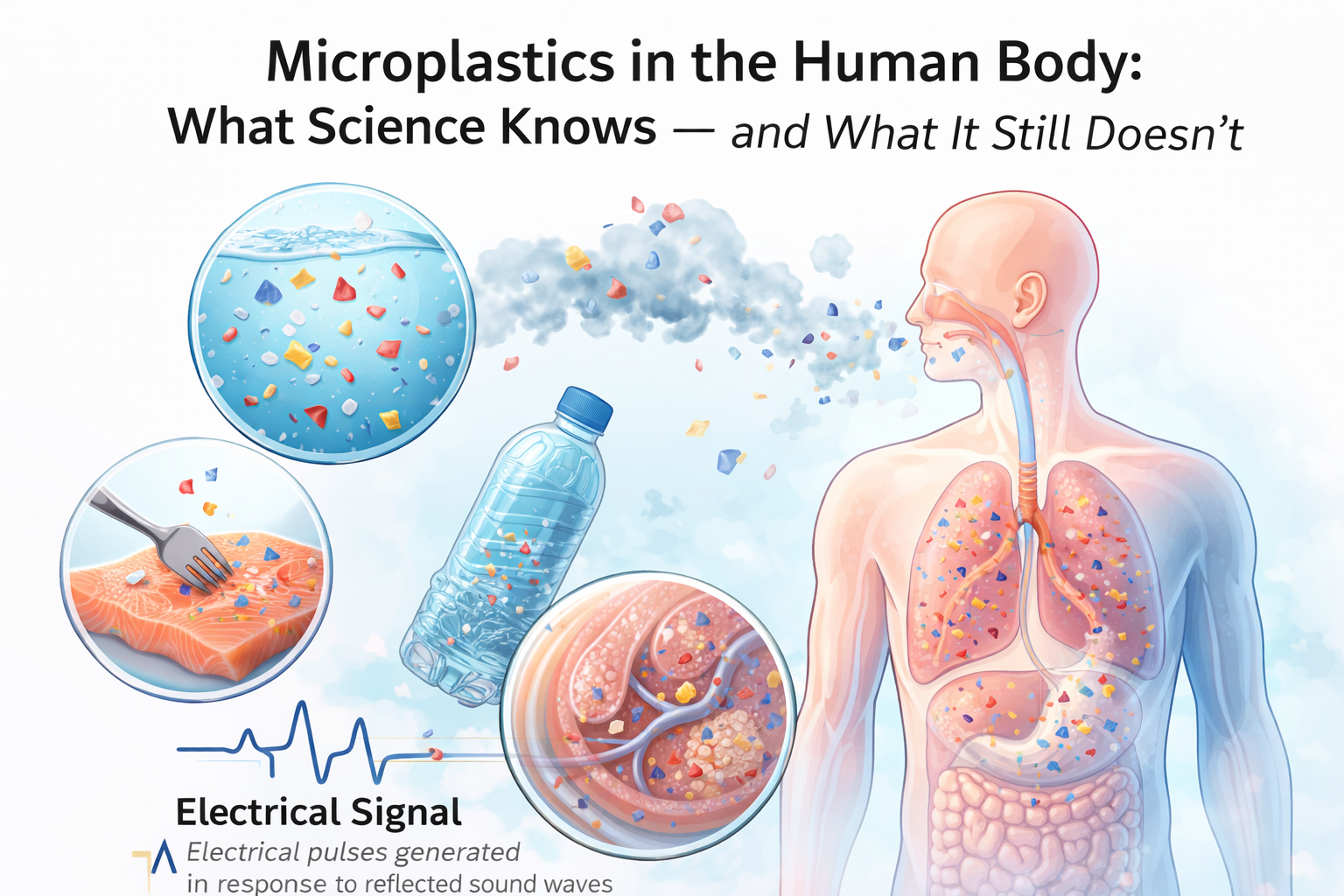
Tiny plastic particles, known as microplastics, have now been detected in human blood, lungs, digestive systems, and even placental tissue. These findings mark a turning point in how scientists, doctors, and policymakers understand plastic pollution—not just as an ecological threat, but as a potential public health issue.
The key question facing science today is no longer whether microplastics are inside us, but:
👉 What does long-term exposure to microplastics mean for human health?
This article explores what science currently knows, what remains uncertain, and why caution—without panic—is the most responsible response.
What Are Microplastics — and Where Do They Come From?
Defining Microplastics
Microplastics are plastic particles smaller than 5 millimeters—often invisible to the naked eye. They exist in countless shapes, sizes, and chemical compositions.
Scientists broadly classify them into two categories:
Primary Microplastics
These are intentionally manufactured small plastic particles, including:
- Microbeads once used in cosmetics and exfoliants
- Industrial abrasives
- Plastic pellets used in manufacturing
(Some of these have been banned in several countries, but many still persist in the environment.)
Secondary Microplastics
These form when larger plastic products break down due to:
- Sunlight (UV radiation)
- Heat
- Mechanical wear and tear
Common sources include:
- Plastic bottles and packaging
- Synthetic clothing fibers
- Tires
- Household plastics
Because plastics degrade extremely slowly, microplastics accumulate and persist in ecosystems for decades.
How Microplastics Enter the Human Body
Humans are exposed to microplastics through multiple everyday pathways, often without realizing it.
Ingestion (Food and Water)
Food and water are considered the primary exposure routes.
Microplastics have been detected in:
- Bottled and tap water
- Seafood and fish
- Salt, grains, fruits, and vegetables
- Processed and packaged foods
These particles can be introduced:
- During food processing
- Through plastic packaging
- Via contaminated water and soil
Over time, regular ingestion leads to continuous low-level exposure.
Inhalation (Airborne Exposure)
Microplastic fibers are now recognized as a significant air pollutant, especially indoors.
Sources include:
- Synthetic textiles
- Carpets and upholstery
- Household dust
Because people spend most of their time indoors, airborne microplastics may rival ingestion as a major exposure source. These fibers can be inhaled and deposited deep in the lungs.
Dermal Contact (Skin Exposure)
Healthy, intact skin acts as a strong protective barrier. However, scientists are still investigating:
- Exposure through damaged skin
- Long-term contact with plastic-containing products
At present, dermal absorption remains the least understood exposure route.
Where Have Microplastics Been Found in the Human Body?
In the last few years, peer-reviewed studies have confirmed microplastics in:
- 🩸 Human blood samples
- 🫁 Lung tissue
- 💩 Digestive tract waste
- 🤰 Placental tissue
These findings suggest that microplastics can cross certain biological barriers, at least under some conditions.
⚠️ Important clarification:
Detection does not equal damage.
Finding particles inside the body does not automatically mean they cause disease—but it does raise serious scientific questions.
Potential Health Risks: What Scientists Suspect
Because large-scale, long-term human studies are still limited, much of the current concern comes from laboratory experiments and animal studies.
Inflammation and Cellular Stress
Lab studies show that microplastics can:
- Trigger inflammatory responses in cells
- Cause oxidative stress
Chronic inflammation is associated with:
- Cardiovascular disease
- Metabolic disorders
- Autoimmune conditions
This raises concerns about long-term, low-dose exposure.
Chemical Exposure and Hormonal Disruption
Plastics are not chemically inert. They often contain:
- Plasticizers
- Flame retardants
- Stabilizers
Microplastics may:
- Leach these additives
- Absorb environmental toxins like heavy metals
This creates concern about endocrine (hormonal) disruption, especially during critical life stages such as pregnancy.
Immune System Effects
Some scientists worry that persistent microplastic exposure could:
- Alter immune responses
- Increase susceptibility to inflammation
- Affect organ-level immunity if particles accumulate
However, clear causal links to specific diseases have not yet been proven.
Why Scientific Certainty Remains Elusive
Studying microplastics in humans is uniquely challenging.
Key scientific barriers include:
- Wide variation in exposure between individuals
- Long latency periods (effects may take decades)
- Ethical limits on human experimentation
- Lack of standardized measurement methods
As a result, most evidence comes from:
- Animal models
- Cell studies
- Observational human research
Public health experts emphasize measured concern, not panic.
The World Health Organization has stated that while current evidence does not confirm clear harm from microplastics in drinking water, major research gaps remain, particularly regarding long-term exposure.
Environmental Inequality and Unequal Exposure
Microplastic exposure is not evenly distributed.
Higher-risk groups may include:
- Urban populations
- Industrial and waste-management workers
- Communities near plastic manufacturing or disposal sites
Low-income regions often face:
- Higher pollution
- Poor waste management
- Limited regulatory enforcement
This raises serious concerns about environmental justice and health inequality.
Can Individuals Reduce Their Exposure?
Completely avoiding microplastics is unrealistic. However, exposure can be reduced.
Practical steps include:
- Reducing single-use plastics
- Using glass or stainless-steel containers
- Avoiding heating food in plastic
- Improving indoor ventilation
- Washing synthetic clothing less frequently (or using fiber filters)
Still, scientists stress:
Individual action alone cannot solve a systemic pollution problem.
Policy and the Global Response
Governments are increasingly recognizing plastic pollution as both an environmental and health issue.
Key policy actions include:
- Bans on certain single-use plastics
- Restrictions on microbeads
- Improved waste management systems
- Recycling reforms
International negotiations are underway for a global plastic pollution treaty, signaling a shift from consumer responsibility toward systemic regulation.
What Research Needs to Answer Next
Critical unanswered questions include:
- Do microplastics accumulate in organs over time?
- What exposure levels are biologically significant?
- How do particle size and chemical composition affect toxicity?
- Are children and pregnant individuals at higher risk?
Answering these will require long-term, interdisciplinary research across medicine, toxicology, and environmental science.
Important Points
- Microplastics are now detected inside the human body
- Presence does not yet equal proven harm
- Inflammation and chemical exposure are key concerns
- Scientific uncertainty remains due to long-term data gaps
- Prevention requires policy change, not just personal habits
A Cautionary Signal, Not a Proven Verdict
Microplastics inside the human body are a powerful symbol of how deeply plastic pollution has penetrated modern life. While science has not yet confirmed widespread health damage, history warns us against complacency.
Substances like asbestos and lead were once considered safe—until decades later, their dangers became undeniable.
Microplastics may follow a similar path, or they may prove less harmful than feared. But the message from science is clear:
Waiting for absolute certainty before acting could come at a high cost.
Responsible policy, continued research, and public awareness offer the best path forward—before the invisible becomes irreversible.