
Mount Kailash vs. Everest: Why the Lower Peak is Harder to Climb
Mount Everest stands at 8,849 meters. It is the highest point on Earth, a brutal death zone of thin air and freezing winds. Yet, over 6,000 people have stood on its summit. Humans have conquered the highest ground on the planet.
Now, look at Mount Kailash. It stands at a modest 6,638 meters—more than 2,000 meters lower than Everest. By mountaineering standards, it should be a straightforward climb. Yet, zero humans have ever stood on its peak.
How is it possible that in the 21st century, with all our satellite technology and advanced gear, a 6,000-meter peak remains unclimbed? Is it a physical barrier, or is it something else? The answer lies in a strange mix of geography, geometry, and divinity.
Is Mount Kailash the Axis Mundi? The Center of the World Theory
A Geographical Miracle
To the ancient world, Mount Kailash wasn’t just a mountain; it was the Axis Mundi—the cosmic needle that stitches the heavens to the earth. Geographically, this claim holds an eerie weight.
- The Source of Life: The mountain is the source of four of Asia’s mightiest rivers: the Indus, the Sutlej, the Brahmaputra, and the Karnali (a tributary of the Ganges). These rivers feed billions of people, fanning out in four directions like the spokes of a wheel.
- The Pyramid Shape: Unlike the jagged, random peaks of the Himalayas, Kailash is distinct. It is a near-perfect tetrahedron (pyramid), with its faces aligning almost perfectly with the four cardinal directions (North, South, East, West).
The Curse of Mount Kailash: Colonel Wilson and the Siberian Climbers

Many have tried to climb Kailash. All have failed. The stories of their attempts hover on the line between hallucination and reality.
The Colonel Wilson Incident
In the early 20th century, a British mountaineer named Colonel R.C. Wilson set out to conquer the peak. He recounted that just as he discovered an easy path to the summit, heavy snow began to fall, blocking his vision and making the ascent impossible. The moment he turned back, the weather cleared. It was as if the mountain was actively rejecting him.
The Siberian “Time Travel” Myth
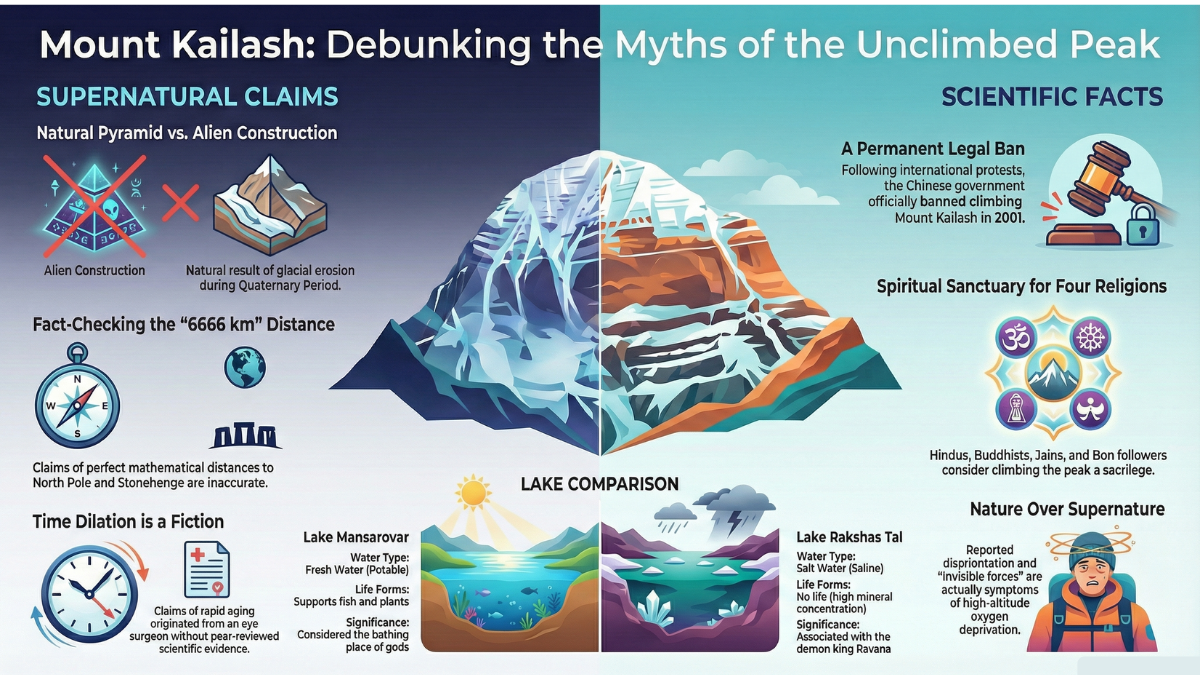
One of the most unsettling urban legends comes from a group of Siberian climbers. The story goes that they crossed a certain point on the mountain and immediately began to age rapidly.
- The Symptoms: Within hours, their hair and nails grew as if weeks had passed. Their skin began to wrinkle.
- The Aftermath: Terrified, they retreated. According to the legend, all the climbers died of old age within a year of the expedition. While this story lacks scientific verification, modern pilgrims often report that their nails and hair grow faster during the 3-day trek (Parikrama) around the base of the mountain.
- Reinhold Messner’s Refusal
In the 1980s, the Chinese government offered Reinhold Messner—the greatest mountaineer in history and the first to climb Everest without oxygen—permission to climb Kailash. Messner refused. His reason was not fear of the climb, but respect for the soul.
“If we conquer this mountain, then we conquer something in people’s souls… I suggest they go and climb something a little harder. Kailash is not so high and not so hard, but it is holy.”
Lake Manasarovar vs. Lake Rakshastal: The Mystery of the Twin Lakes
At the foot of the mountain lie two lakes that defy scientific explanation. They are neighbors, yet they are opposites in every way.
Lake Manasarovar: The Sun
- Shape: Round, like the Sun.
- Water: Fresh, sweet, and drinkable.
- Nature: Calm and placid. Even on windy days, the surface often remains mirror-like.
- Significance: Represents purity and light.
Lake Rakshastal: The Moon
- Shape: Crescent, like the Moon.
- Water: Salty and lifeless. No fish swim here; no weeds grow.
- Nature: Turbulent. Even when the air is still, this lake is often choppy and restless.
- Significance: Represents the demon king Ravana and the darkness of the ego.
The two lakes are connected by a thin channel, symbolizing the eternal balance between good and evil, light and dark, existing within us all.
Why Mount Kailash is Sacred to Four Religions (Hinduism, Buddhism, Jainism, Bon)

Why is the ban so strictly enforced? Because stepping on the peak is considered an act of supreme sacrilege for four major religions.
- Hinduism: This is the abode of Lord Shiva, the Destroyer, who sits in eternal meditation with his wife Parvati. To climb it is to step on the head of God.
- Buddhism: It is the home of Demchok (Chakrasamvara), representing supreme bliss. Milarepa, the Tibetan sage, is the only human said to have scaled it—not with ropes, but using the rays of the sun.
- Jainism: It is called Ashtapada, the place where the first Tirthankara, Rishabhadeva, attained liberation (Moksha).
- Bon: The ancient pre-Buddhist religion of Tibet believes the mountain is a nine-story Swastika mountain that serves as the seat of the Sky Goddess.
Conclusion: Some Doors Should Remain Closed
In a world where humans have mapped the ocean floor and planted flags on the moon, Mount Kailash represents the final frontier of the unknown.
It challenges our ego. We are obsessed with conquering, claiming, and measuring. But Kailash asks us to do something harder: to bow down and walk around.
The mystery of Mount Kailash isn’t just about whether it can be climbed. It is about the understanding that some places are not meant for our footprints. They are meant for our spirits.
Also Read: