
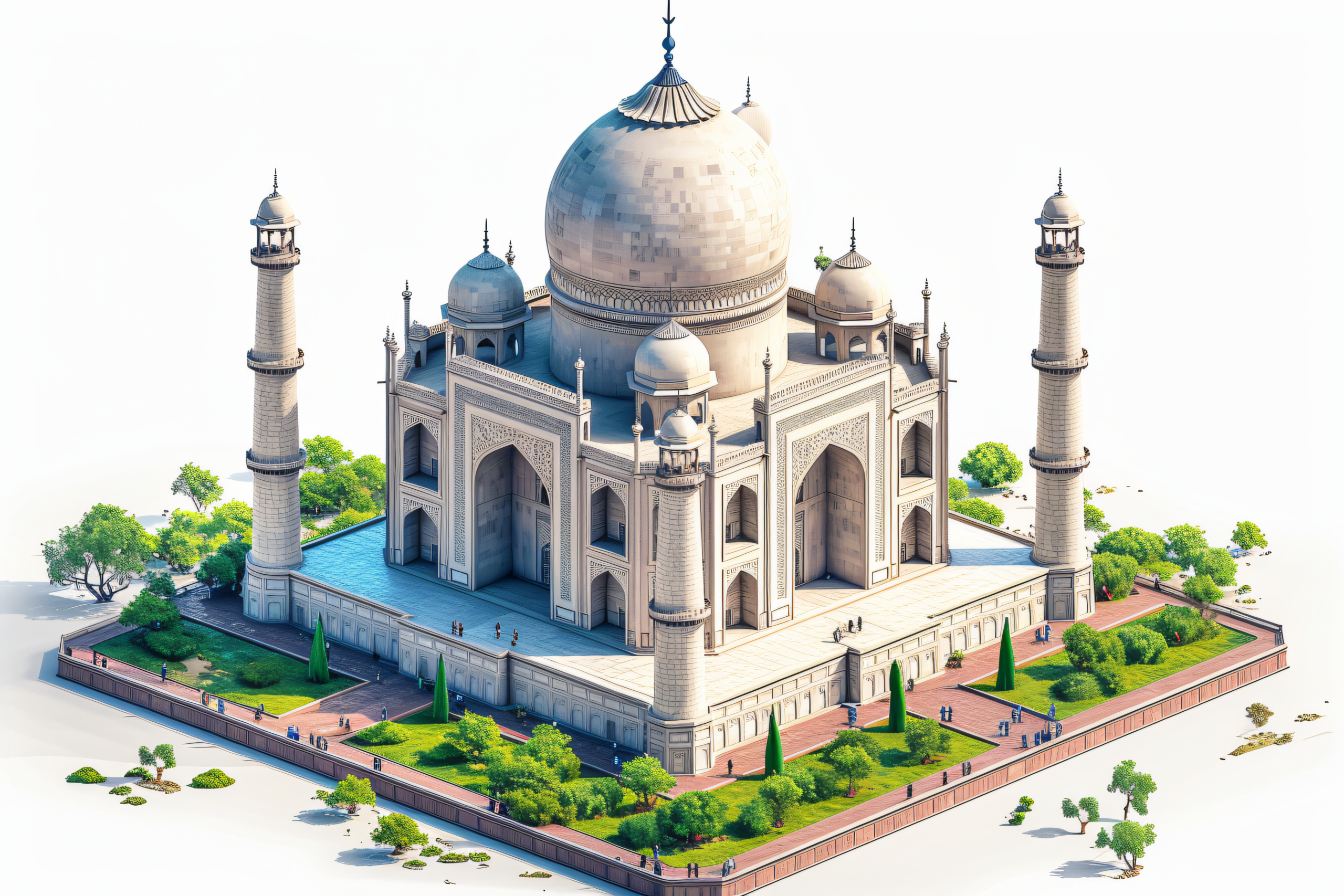
Is the Taj Mahal actually a Shiva temple named Tejo Mahalaya? We uncover the truth behind P.N. Oak’s theories. .Also we in this article we will figure out what is hidden inside the 22 locked rooms of the Taj Mahal and the ‘chopped hands’ myth?
Let’s begin with the mystery of the Taj Mahal..
The Mystery of the Taj Mahal: Debunking the Tejo Mahalaya and Chopped Hands Myths
For centuries, the Taj Mahal has stood as the ultimate symbol of love—a white marble poetry written by an Emperor for his favorite Queen. Millions of tourists flock to Agra every year to witness its beauty. However, in recent years, a different kind of fog has surrounded the monument.
It isn’t the winter fog of the Yamuna, but a fog of conspiracy theories. From “WhatsApp University” forwards to courtroom petitions, rumors persist that the Taj Mahal is actually a Shiva temple named Tejo Mahalaya, that there are secrets hidden behind Taj Mahal 22 locked rooms, and that the hands of the workers who built it were brutally chopped off.
But does history back these claims? Or are we letting fiction overshadow one of the world’s greatest architectural marvels? Let’s separate the facts from the myths.
What is Inside the 22 Locked Rooms of the Taj Mahal? (ASI Explanation)
The internet loves a good mystery, and nothing sells better than “secret rooms.” The theory suggests that underneath the main structure of the Taj Mahal, there are 22 permanently locked rooms that hide Hindu idols, proving the monument’s pre-Islamic origin.
This theory moved from social media to the legal system in May 2022. A petition was filed by a media-in-charge of the BJP’s Ayodhya unit in the Allahabad High Court. The plea demanded that the Archaeological Survey of India (ASI) open these 22 rooms to search for evidence of Hindu idols or scriptures.
The court’s response was swift and stinging. The bench dismissed the petition, stating it was a “mockery of the PIL system,” and famously asked the petitioner to “go and research” before wasting the court’s time. They refused to turn a historical debate into a judicial matter without credible evidence.
The ASI’s Official Explanation: Corridors, Not Secret Rooms
So, what is actually down there? The ASI (Archaeological Survey of India) has clarified this multiple times.
- Structural Support: The Taj Mahal stands on a massive raised plinth. The “rooms” in the basement are essentially a long, arched corridor. This design was necessary to distribute the massive weight of the marble structure above and prevent it from sinking into the soft riverbank soil.
- Why are they locked? It isn’t a conspiracy; it’s conservation. The underground cells are made of marble and sandstone. If they were open to the 100,000+ daily visitors, the Carbon Dioxide (CO2) from human breath would react with the calcium carbonate in the marble, causing it to flake and deteriorate.
- Maintenance: These areas are not “sealed forever.” ASI staff open them regularly for cleaning and structural inspection. In an unprecedented move to quell the rumors, the ASI even released photos of these restoration works, showing nothing but empty, arched corridors—no idols, no secret altars, just plain walls.
Is Taj Mahal a Shiva Temple? The Origin of the ‘Tejo Mahalaya’ Theory
The most persistent myth is that Shah Jahan did not build the Taj Mahal but merely remodeled an existing Rajput temple/palace.
Who Was P.N. Oak? The Man Behind the Temple Conspiracy
This theory didn’t come from ancient texts; it came from a man named P.N. Oak in the 1960s and 70s. Oak was a self-proclaimed historian who founded the “Institute for Rewriting Indian History.”
Oak’s methodology was less about archaeology and more about “creative linguistics.” For example:
- He claimed the Vatican was originally a Hindu “Vatika” (garden).
- He claimed Christianity was a corruption of “Chrisn-Nity” (Ethics of Krishna).
- He claimed the Kaaba in Mecca was a Shiva temple.
Using this same logic, he argued that “Taj Mahal” was a corruption of “Tejo Mahalaya” (Abode of Shiva). While his theories are popular in modern conspiracy circles, the Supreme Court of India dismissed his petition in 2000 as “misconceived,” and mainstream historians largely reject his work due to a lack of evidence.
Did Shah Jahan Steal Raja Jai Singh’s Property?
A key pillar of the temple theory is that the land belonged to Raja Jai Singh and was “stolen” by Shah Jahan.
History tells a different, more diplomatic story. It is true that the land belonged to Raja Jai Singh (the grandson of Raja Maan Singh). However, Shah Jahan and Raja Jai Singh were not enemies; they were allies. Shah Jahan was the grandson of Akbar, and Jai Singh was the grandson of one of Akbar’s most trusted generals.
Official court documents (Firmans) from the era exist. They detail a transaction dated December 28, 1633. Shah Jahan did not seize the land; he exchanged it. In return for the riverside plot in Agra, Raja Jai Singh was gifted four grand mansions from the Emperor’s private estate (specifically, the estates of Raja Bhagwan Das, Madho Singh, Ruup Siingh, and Chandar Singh). It was a documented real estate swap, not a conquest.
Government and Court Rulings
In both 2015 and 2017, the Union Ministry of Culture and the ASI stated in court that there is no evidence whatsoever—archeological, literary, or epigraphic—to suggest the Taj Mahal was ever a temple.
Did Shah Jahan Really Maim 20,000 Workers?
“Shah Jahan cut off the hands of the workers so they could never build anything as beautiful again.” We have all heard this story. It paints the Emperor as a cruel tyrant, but does it hold water?
Why the ‘Chopped Hands’ Story is Logistically Impossible
Think about the logistics. The Taj Mahal took about 22 years to build with a workforce of nearly 20,000 artisans. If the Emperor ordered 20,000 pairs of hands to be chopped off:
- There would be mass graves of skeletons with severed hands found near Agra. None exist.
- There would be a massive revolt. You cannot maim an army of workers and expect peace.
- European travelers like Bernier and Tavernier, who wrote detailed critical accounts of the Mughal court, never mentioned this atrocity.
Historical Evidence: Taj Ganj and Future Monuments
- The strongest proof against this myth is the existence of Taj Ganj. This is a settlement right next to the Taj Mahal, established by Shah Jahan to house the workers. Their descendants still live there today, and none recount stories of mutilated ancestors.
Furthermore, the chronology doesn’t match. After the Taj Mahal was completed, Shah Jahan commissioned the Red Fort and the Jama Masjid in Delhi. These structures were built by the same guilds of architects and masons. If he had chopped off their hands, who built the rest of Mughal India?
- Historians believe the “chopped hands” story is a metaphor that got lost in translation. It likely meant the workers signed a contract binding their “hands” (skills) exclusively to the Emperor, or they were paid so handsomely that they would never need to work again.
The True History: Shah Jahan and Mumtaz Mahal
When we strip away the myths, the reality is equally fascinating.
A Love Story Beyond Politics
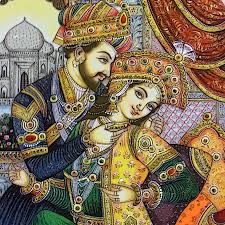
Prince Khurram (later Shah Jahan) met Arjumand Banu Begum (later Mumtaz Mahal) when they were teenagers. In an era of political alliances, their marriage in 1612 was a genuine love match. While Shah Jahan had other wives for political reasons, court chroniclers noted that his relationship with them was “nothing more than the status of marriage.” Mumtaz was his soulmate, his advisor, and his constant companion, even on military campaigns.
Her death in 1631, while giving birth to their 14th child, shattered the Emperor. His hair reportedly turned white within months of her passing.
Construction of a World Wonder
To deal with his grief, he poured the empire’s wealth into her mausoleum. It was a global effort:
- White Marble: From Makrana, Rajasthan.
- Jade and Crystal: From China.
- Turquoise: From Tibet.
- Sapphire: From Sri Lanka.
- Carnelian: From Arabia.
The construction began in 1632 and finished in 1653. It wasn’t just a building; it was a representation of paradise on earth.
Appreciating the Architectural Marvel

More than just a tomb, the Taj Mahal is the pinnacle of Mughal architecture, fusing Islamic, Persian, and Indian design elements. While conspiracy theories make for exciting WhatsApp forwards, they often crumble under the weight of historical documents and architectural logic.
The Taj Mahal is a UNESCO World Heritage Site and the pride of India. Perhaps the greatest secret of the Taj Mahal isn’t hidden in a locked room but is visible in plain sight: the enduring power of human grief and the beauty it can create.
Also Read: