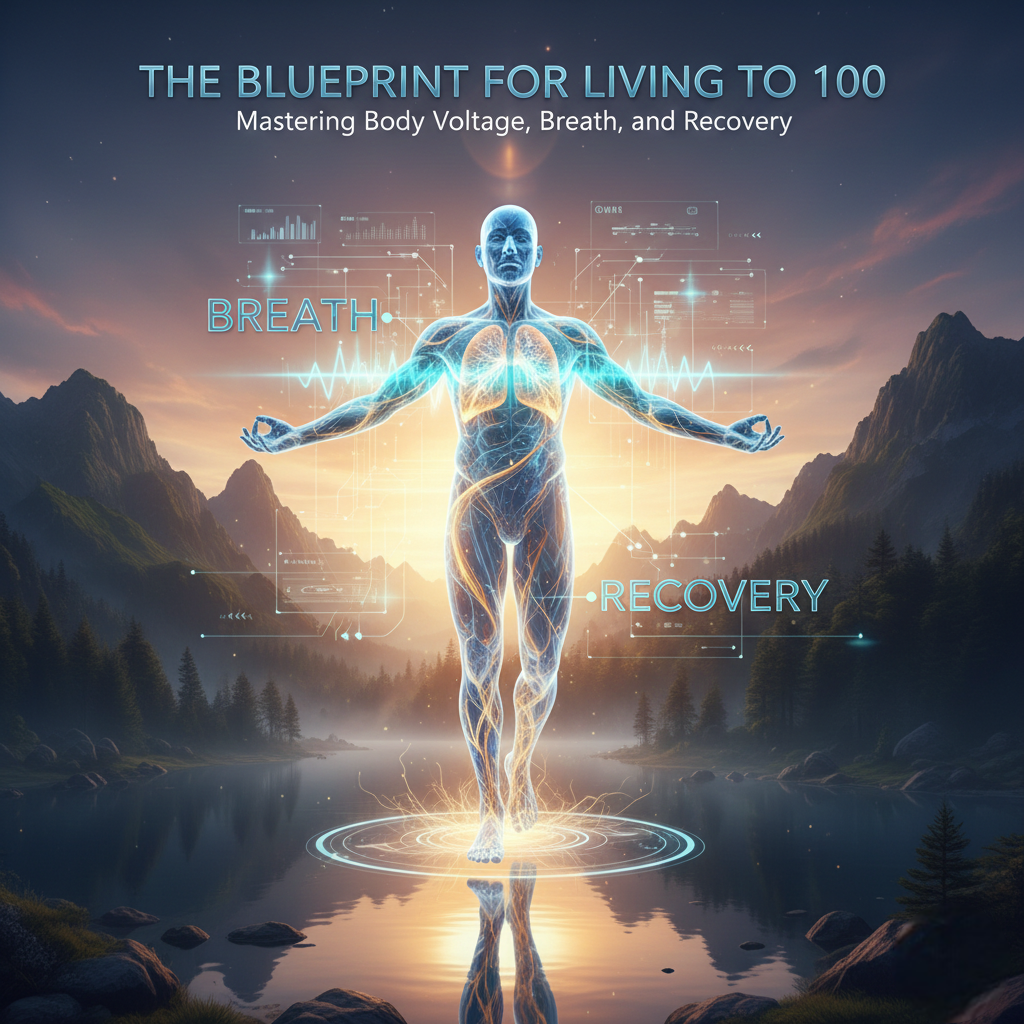
Discussing various natural strategies to increase human longevity and reach a “century” of life. Emphasizing on the importance of earthing—physically connecting with the ground to lower the body’s electrical voltage—and warns against the negative energy of artificial plants and proximity to mobile chargers. Highlighting on proper breathing techniques, such as increasing vital lung capacity to improve blood purification, and the health benefits of magnesium and alkaline diets. Providing insights into professional athlete training, explaining how recovery, warming up, and spinal alignment are crucial for preventing injuries. Furthermore, explores brain mapping, identifying the “alpha” state as the ideal frequency for peak performance and happiness.
We often wonder why our average lifespan isn’t hitting the century mark. Humans are designed to live long, healthy lives, yet we are stopped short. We possess the experience and talent to contribute to the world, but ill health pulls us back. The culprit? Often, it is the very technology that surrounds us, our changing habits, and a disconnection from nature. Detailed guiding on how to reclaim your health, drawing from physiotherapy, ancient wisdom, and modern science.
The Science of “Earthing” and Body Voltage
One of the most overlooked aspects of modern health is human body voltage. Just like electronics have a voltage rating, so does the human body. When this voltage gets too high, it leads to inflammation, blood pressure issues, stress, and sleep problems.
In the past, farmers worked barefoot on the soil, and people walked on beaches without shoes. This provided “earthing“—a natural way to discharge excess voltage into the ground. Today, we live in high-rise buildings, walk on carpets, marble, or cement, and wear rubber-soled shoes. We are insulated from the earth.
We can measure this. A person might have a body voltage of 300-400 millivolts indoors. The moment they touch the earth, it drops significantly. Since we can’t always be outdoors, technology now offers “earthing mats.” These plug into the grounding port of a standard outlet (not the electricity) and connect you to the earth. Sleeping on such a mat or placing your feet on one while working can drain that excess voltage, keeping your cells at a healthy, low-voltage state.
Conversely, electronic chargers are harmful. If you sleep with your phone charging next to your head, your body voltage skyrockets. Even if the switch is just on, the radiation affects you. Chargers and WiFi routers should be in a different room while you sleep.
Breathing: The Lost Capacity
Our lungs are designed to hold about 4.5 to 5.5 liters of air. However, most modern individuals, especially those with sedentary lifestyles, have a vital capacity of less than 2 liters. This was a critical factor during the COVID-19 pandemic; those with low vital capacity were the most vulnerable.
The air contains only about 20% oxygen. When you breathe shallowly (2 liters), you get very little oxygen to purify your blood. If you increase your capacity to 4 liters, you double that intake, leading to purer blood and better health.
How to breathe correctly: Most people breathe using their shoulders. Correct breathing involves the stomach. When you inhale, your stomach should come out; when you exhale, it should go in. You should practice inhaling deeply through the nose and exhaling slowly through the teeth to improve lung capacity.
The Ozone Hour: Morning walkers are generally healthier than evening walkers. Why? Because about 90 minutes before sunrise until the sun comes up, the universe releases a layer of ozone. This is incredibly healthy. You will notice birds and animals wake up and go out during this time—not to hunt, but to absorb this ozone and drink water. We should follow suit: wake up early (around 4:30 or 5:00 AM), drink room-temperature water first thing to replenish fluids lost during sleep, and catch that ozone.
Sleep Hygiene and Restoration
Sleep is when the body repairs itself, specifically between 11:00 PM and 4:00 AM. If you sleep late and wake up late, you miss this critical repair window. You must aim for at least 7 to 8 hours of sleep. Quality matters more than just quantity—many people suffer from sleep apnea, where breathing stops dozens of times an hour, starving the brain of oxygen and leading to various diseases.
Sleeping Position: The best position to sleep in is on your right side. This puts the least pressure on the heart. The left side is the second-best option. Avoid sleeping flat on your stomach. In terms of direction, keeping your head toward the East is traditionally considered beneficial.
Diet, Digestion, and Gut Health
The way we eat has changed drastically. We used to sit on the floor; now we sit at tables. Sitting cross-legged on the floor creates pressure on the stomach (about 1/4th), which naturally prevents overeating. When you sit at a table watching TV, the body gets confused about whether to digest food or process the entertainment, and you end up overeating.
The Water Rule: Do not drink water immediately after eating. Food needs “fire” to digest. Drinking cold water or soft drinks douses this fire, leading to poor digestion. Wait at least 45 minutes to an hour.
Colon Cleansing: Over time, undigested food, especially fats, sticks to the walls of the large intestine. This prevents medicines and nutrients from being absorbed. Hydro Colon Therapy (using water to clean the bowel) is recommended once every six months to keep the system clean and efficient.
Magnesium and Vitamins: Many people suffer from aches and pains simply due to a magnesium deficiency. Magnesium is essential for holding Vitamin D3 and B12 in the body. Without it, even if you take supplements, they won’t be absorbed.
• Sources: Black chickpeas (Chana), pumpkin seeds, and bottle gourd seeds are rich in magnesium.
• The Epsom Salt Hack: If you have leg pain or insomnia, dissolve Epsom salt in a bucket of warm water and soak your feet. The magnesium absorbs through the skin, and you will sleep deeper than ever before.
Home Environment: Plants and Energy
Stop keeping artificial flowers and plants in your home. They are non-living and accumulate negative energy. Instead, keep real plants. Even a small plant gives oxygen.
• Snake Plant: Excellent for indoors, can survive in low light, and gives high oxygen.
• Money Plant & Bamboo: Good options that can grow in water or soil. If a plant dies, it’s a sign it wasn’t maintained, but always replace it with a living one to keep the energy and oxygen flowing.
Pain Management and Physiotherapy Myths
Pain is a signal from the body that something is wrong. We often try to silence this signal with instant-relief sprays or balms. These are “counter-irritants“—they irritate the skin nerves to distract the brain from the actual pain, but they do not cure the injury. If the pain is masked, you might continue to use the injured part and cause more damage.
The Rule of Ice: For any new injury (sprain, muscle pull), use ice for the first 72 hours (3 days). Apply an ice pack for 20 minutes only. Freezing it longer doesn’t help; the effect happens in the first 20 minutes. Never use heat immediately on a fresh injury as it increases bleeding/swelling.
Posture & Spine: We spend too much time hunching forward (looking at phones/laptops). We need to “unwind” the spine. Lying on your stomach with a pillow under your chest for 30 minutes while watching TV can help realign the spine. Also, swimming is the best exercise because it works the whole body and aligns the spine, unlike walking which primarily uses the legs.
Insights from Elite Sports (Cricket)
In the past, cricket selection was based purely on talent. Today, fitness is the entry barrier. If you aren’t fit, you don’t play.
• Rest Days: Players are advised to have one complete rest day a week—this means “breakfast, lunch, and dinner on the bed.” No activity. This allows the body to fully recover.
• Warm-up & Cool-down: You must cool down for half the time you warmed up. If you warm up for 40 minutes, take 20 minutes to stretch and cool down. This prevents injuries.
• Discipline: Top athletes like Virat Kohli are incredibly disciplined with sleep and diet. They work specifically on power, strength, and speed.
• Injuries: Hamstring pulls and shoulder injuries are common. Sometimes, shoulders dislocate and have to be put back in place immediately on the field.
Brain Mapping and The Alpha State
Our brain operates in five frequency zones:
1. Delta: Deep sleep.
2. Theta: Drowsiness/dreaming.
3. Alpha: The zone of peak performance and happiness.
4. Beta: Alertness/Stress.
5. Gamma: Hyper-alertness/Confusion.
When athletes perform their best (e.g., scoring a century), they are usually in the Alpha state. When they fail, they are often in Beta or Gamma (high stress). The goal is to reach Alpha. You can get there through meditation, listening to soothing sounds, or simply being happy and enjoying the moment. Interestingly, while your mouth can lie, your brain cannot—brain mapping can detect lies by seeing the frequency shift out of Alpha.
The Medical Potential of Cannabis (CBD)
There is a difference between the drug part of cannabis (THC) and the medicinal part (CBD). The leaf has been part of Indian culture for centuries (e.g., Lord Shiva). Today, science extracts CBD oil for medical use. It is effective for conditions like epilepsy in children, rheumatism, and even cancer management. It aids sleep and pain relief without the addiction associated with other drugs. It is available legally under Ayush prescriptions as “Vijaya” extract.
A Final Challenge: The No-Gossip Rule
Finally, mental health is just as important as physical health. A powerful way to improve your life is to stop gossiping. If you talk about others, you take on their negative energy. Try this challenge: For 40 days, do not speak ill of anyone or gossip. You will see a guaranteed transformation in your life.